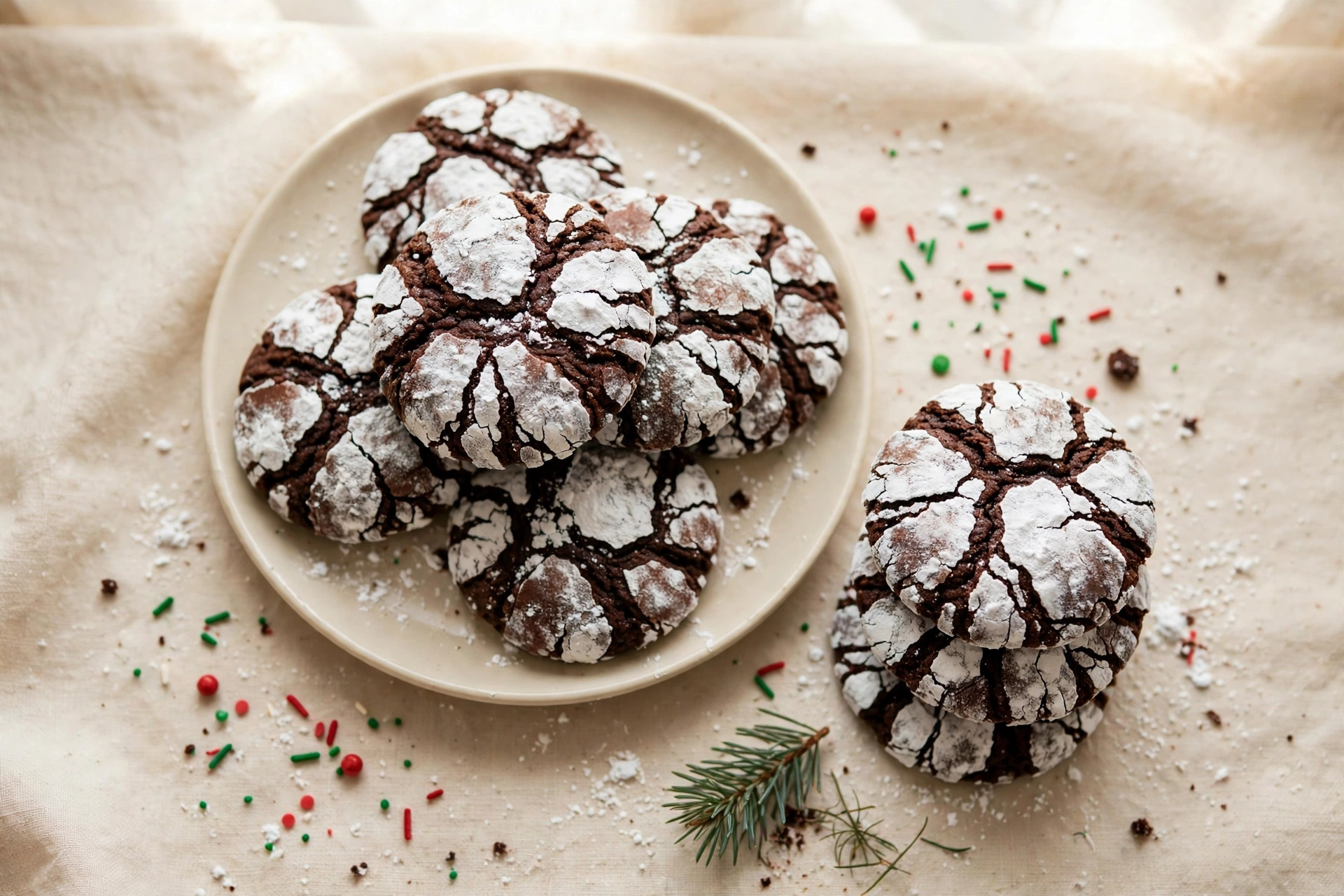
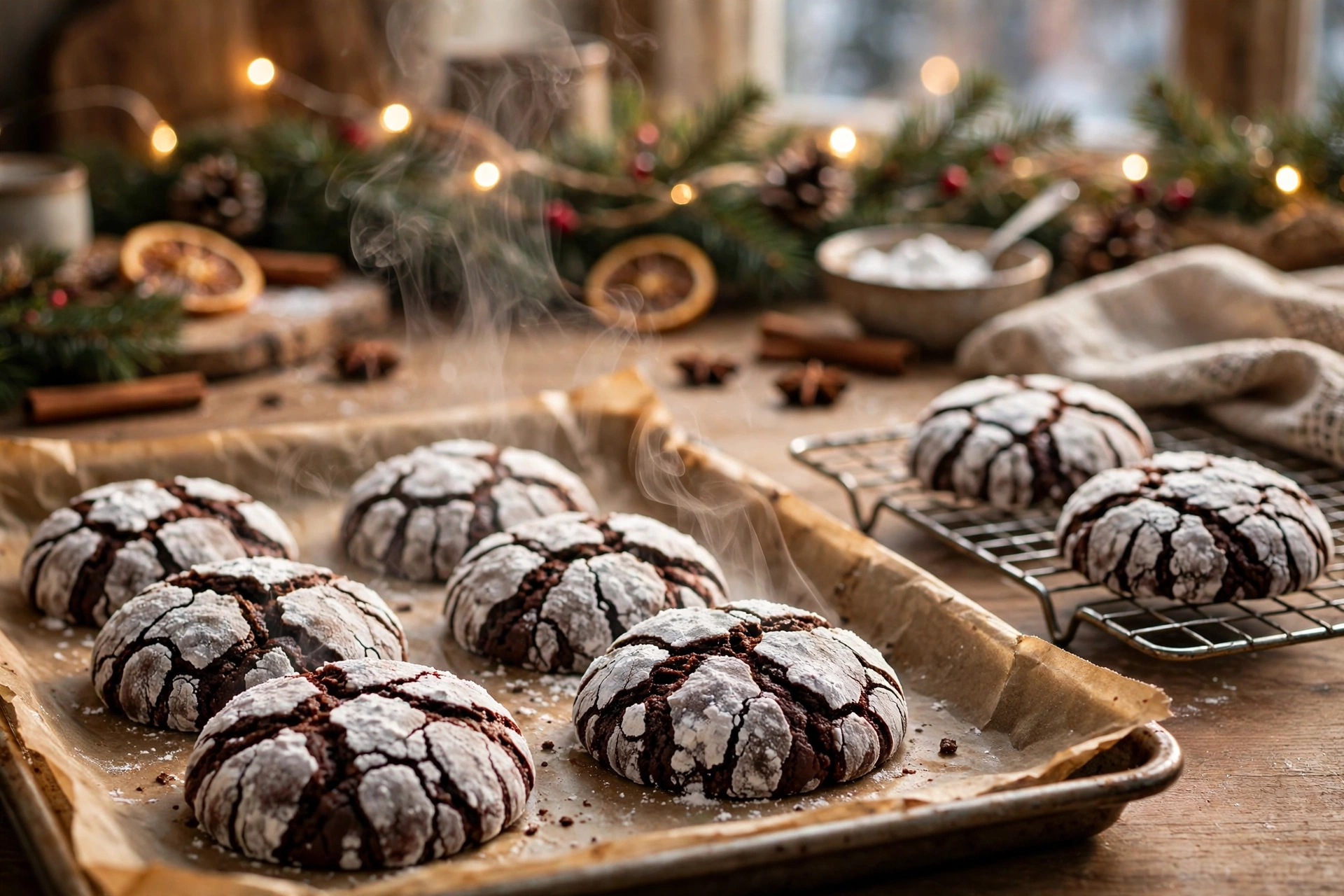
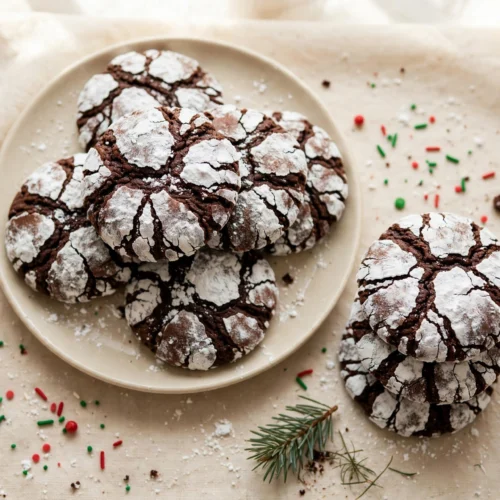
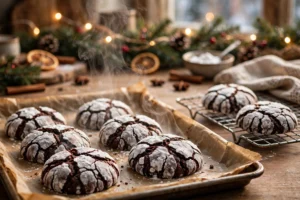
Some cookies look like Christmas before you even taste them, and these Christmas crinkle cookies are exactly that kind. They are dark, fudgy chocolate rounds with snowy white tops that crack open in the oven, so every cookie looks dusted with fresh snow. The outside is lightly crisp, the middle stays soft like a brownie.
This Christmas crinkle cookies recipe takes about 20 minutes of hands-on work, plus a short chill and a 12-minute bake. Mix one bowl of chocolate dough, chill it until firm, roll it into balls, and coat each ball twice in sugar. That double sugar coat is the whole secret — it makes the white tops split into beautiful dark cracks.

Why You’ll Love It
- They look like Christmas. Dark chocolate cracks under snowy powdered sugar — no decorating needed.
- Fudgy centers. The middles stay soft and brownie-like, even after the cookies cool.
- One bowl, no mixer. You only need a bowl, a whisk, and a spoon to make the dough.
- Ready in about an hour. Twenty minutes of hands-on work, a short chill, and a quick bake.
- Made for cookie trays. They hold their shape, travel well, and look beautiful next to any other cookie.
- Freezer-friendly. Freeze the dough balls or the baked cookies, so holiday baking never feels rushed.
- Easy to make your own. Add peppermint, swap in dark cocoa, or roll them in crushed candy canes.
Ingredients
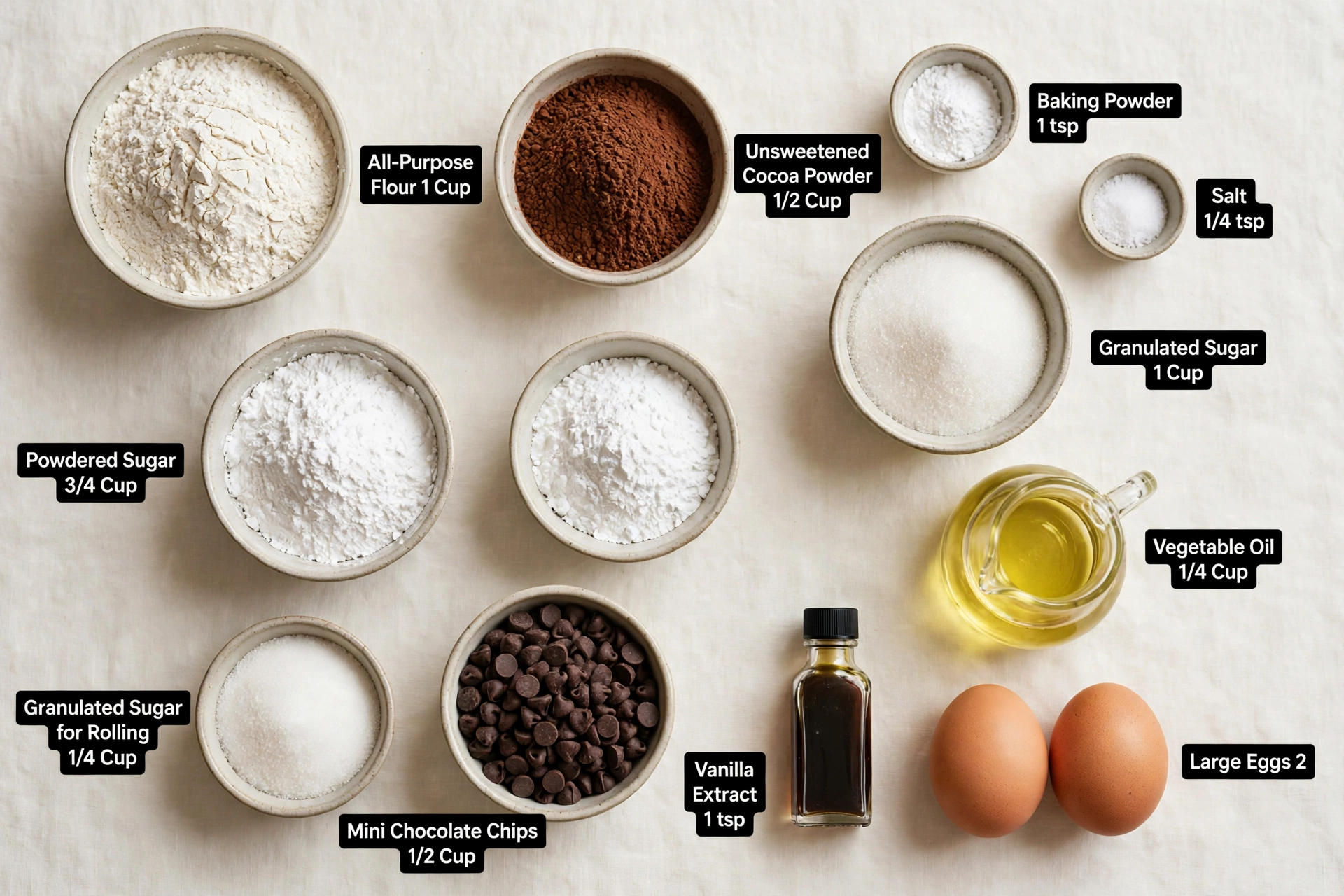
The Dry Ingredients
- 1 cup all-purpose flour — The structure of the cookie. Flour gives the dough just enough body to hold a tall, round shape while the centers stay soft. Spoon it into the cup and level it off, because a packed cup makes dry, cakey cookies. Substitution: 1 cup gluten-free all-purpose flour blend with xanthan gum.
- 1/2 cup unsweetened cocoa powder — The deep chocolate flavor and the dark color that makes the white cracks stand out. Natural cocoa gives a classic chocolate taste, while Dutch-process cocoa makes a darker, richer cookie. Substitution: 1/2 cup Dutch-process cocoa powder, for a darker crinkle.
- 1 teaspoon baking powder — The lift that cracks the sugar coat open. It gives the cookies a fast rise in the hot oven, and that quick puff is what splits the powdered sugar into cracks. Make sure yours is fresh, because old baking powder loses its power. Substitution: there is no good substitute here — do not swap in baking soda, which changes the flavor and the spread.
- 1/4 teaspoon salt — The flavor sharpener. Salt wakes up the chocolate and keeps the cookies from tasting flat or one-note sweet. Substitution: 1/4 teaspoon fine sea salt.
The Wet Ingredients
- 1 cup granulated sugar — Sweetness and a crisp edge. Sugar sweetens the dough, and it helps the outside of the cookie set with a light crunch while the middle stays fudgy. Substitution: 1 cup light brown sugar, for a softer cookie with a hint of molasses.
- 1/4 cup vegetable oil — Moisture and fudge. Oil keeps the crumb soft and brownie-like for days, and it mixes into the cocoa more easily than butter does. Substitution: 1/4 cup melted unsalted butter, cooled; or 1/4 cup canola oil.
- 2 large eggs, at room temperature — The binder that holds the dough together. Room-temperature eggs mix into the dough far more smoothly than cold ones. Substitution: 2 flax eggs (2 tablespoons ground flaxseed + 6 tablespoons water, rested 5 minutes), though the cookies will be a little denser.
- 1 teaspoon vanilla extract — Warmth behind the chocolate. Vanilla rounds out the cocoa and makes the whole cookie taste more like itself. Substitution: 1 teaspoon vanilla bean paste.
- 1/2 cup mini chocolate chips — Pockets of melted chocolate in every bite. Mini chips melt into the crumb as the cookies bake, so the centers taste even fudgier. Substitution: 1/2 cup chopped dark chocolate, or leave them out for a plainer crinkle.
For Rolling
- 1/4 cup granulated sugar — The first coat, and the secret to a strong crackle. Granulated sugar clings to the sticky dough and forms a thin, crisp layer under the powdered sugar. That layer is what cracks open in the oven. Substitution: 1/4 cup coarse sanding sugar, for extra sparkle.
- 3/4 cup powdered sugar — The snowy white coat. Powdered sugar sits on top of the granulated layer and stays bright white, so the dark cracks show up beautifully against it. Roll the balls thickly — a light dusting melts away in the oven. Substitution: 3/4 cup powdered sugar mixed with 1 tablespoon cornstarch, if your kitchen is very humid.
How to Make Christmas Crinkle Cookies
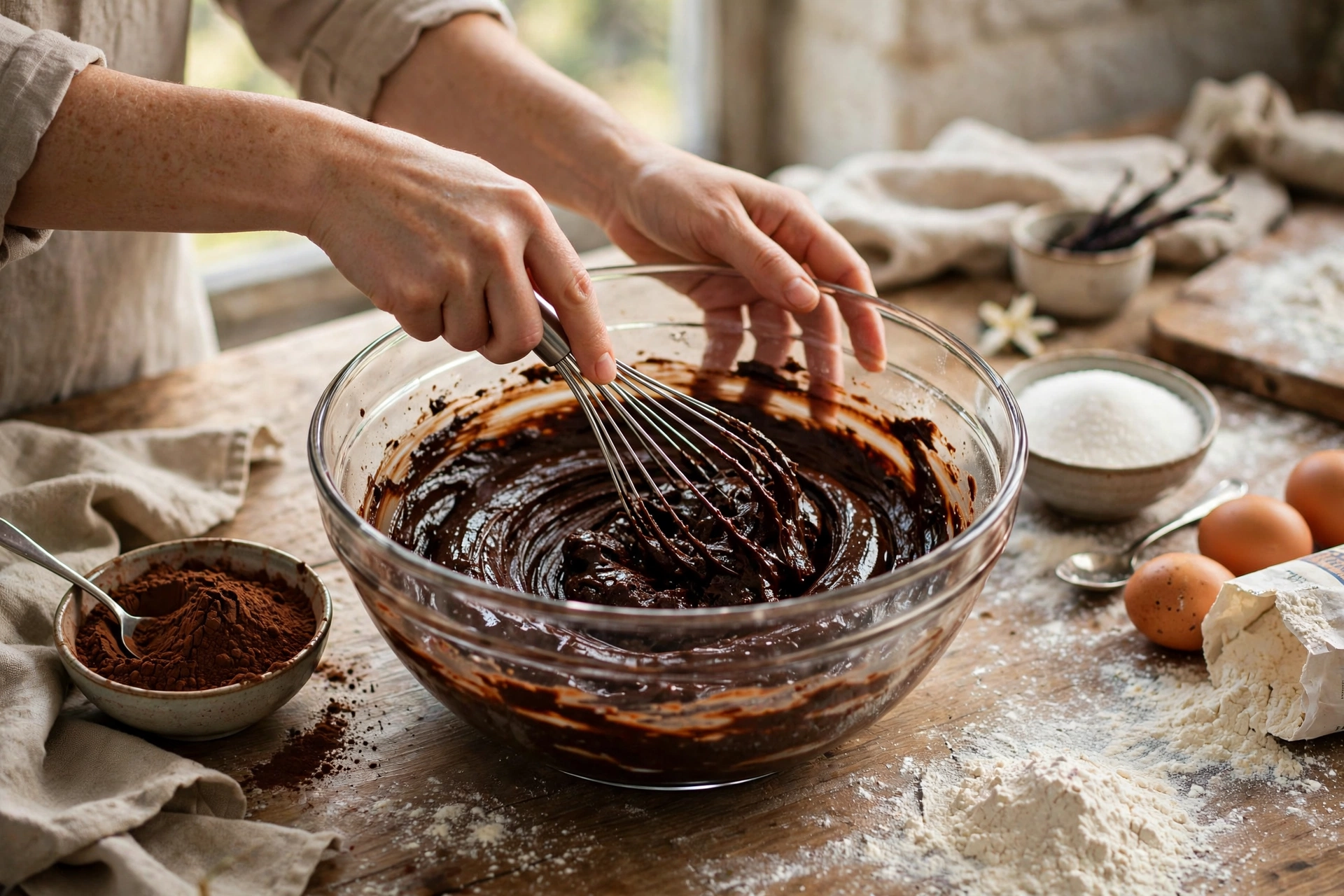
1Step 1: Mix the Chocolate Base
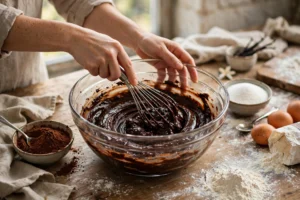
Mix the chocolate base. In a large bowl, whisk the granulated sugar, cocoa powder, and vegetable oil into a thick, dark paste — a little grainy at first, and that is exactly right. Add the eggs one at a time, whisking well after each one, then stir in the vanilla until the batter turns glossy and smooth.
2Step 2: Add the Dry Ingredients
Add the dry ingredients. Whisk the flour, baking powder, and salt in a separate bowl, then add the dry mixture to the chocolate bowl a little at a time, stirring gently until no dry streaks remain. Fold in the mini chocolate chips. The dough will be soft and sticky, almost like thick brownie batter — do not add more flour, because the chill will firm it up.
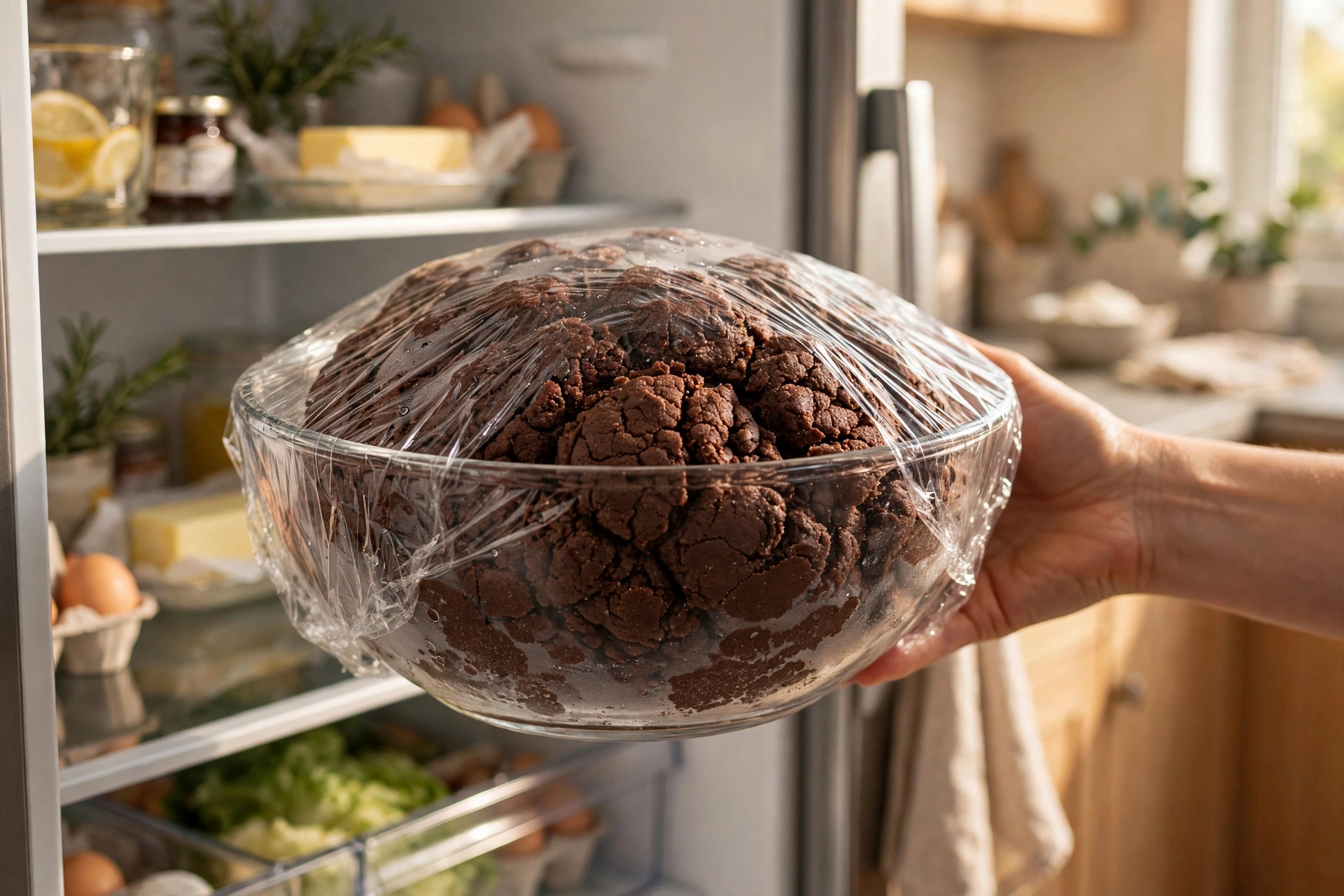
3Step 3: Chill the Dough
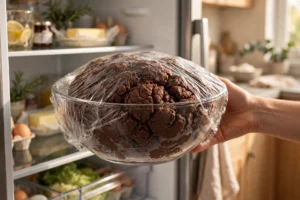
Chill the dough. Cover the bowl tightly and refrigerate for 30 minutes, until the dough is firm enough to roll. That is the minimum. It keeps in the fridge for up to 24 hours — let it sit on the counter for 10 minutes before rolling if it feels rock-hard.
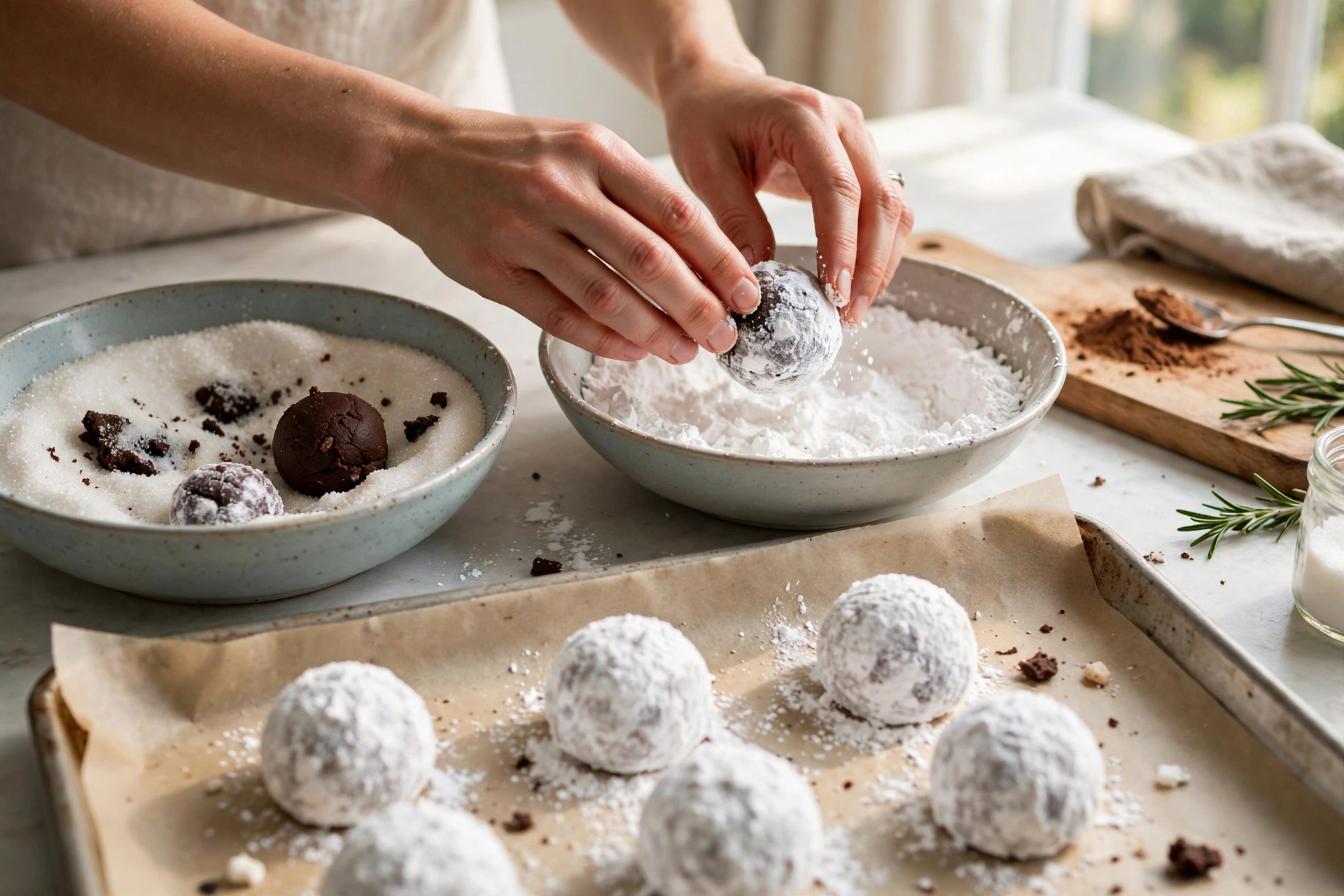
4Step 4: Roll in Sugar — Twice
Roll in sugar — twice. Heat the oven to 350°F and line two baking sheets with parchment. Put the granulated sugar in one small bowl and the powdered sugar in another. Scoop about 1 1/2 tablespoons of dough per cookie and roll it into a smooth ball. Roll each ball first in the granulated sugar, then thickly in the powdered sugar until it looks like a snowball. Place the balls 2 inches apart on the sheets.
5Step 5: Bake
Bake. Bake for 12 minutes, until the edges are set and the tops have cracked open wide. The centers will still look soft, and that is what you want — they firm up as they cool, and baking until the centers look done turns the cookies dry. Bake one sheet at a time for the most even crackle.
6Step 6: Cool and Serve
Cool and serve. Let the cookies cool on the baking sheet for 10 minutes, then move them gently to a wire rack to cool completely. If any cookie looks a little bare, dust it with a pinch more powdered sugar while it is still warm.
Technique: The Crackle System — Chill, Roll, Bake
A crinkle cookie earns its name in the oven, and the crackle is not luck. It comes from three steps working together: a cold dough, a double sugar coat, and a hot oven. Skip any one of them and the tops stay smooth or the sugar melts away.
The Chill
Chilling is the step people most want to skip, and it is the one that matters most. Warm dough spreads fast in the oven and flattens before the sugar coat can crack, so you get thin, smooth cookies with grey, melted sugar. Cold dough holds its shape and rises slowly, so the sugar shell has to split to make room — and that split is the crackle. Thirty minutes in the fridge is the minimum. In a warm kitchen, give it a full hour, and keep the dough cold between batches.
The Double Roll
The double roll keeps the powdered sugar bright white. Granulated sugar goes on first and does two jobs: it clings to the sticky dough and gives the powdered sugar something dry to sit on, so the fine sugar does not soak in and disappear, and it forms a thin, crisp shell that cracks as the cookie rises. Then the powdered sugar goes on thickly over the top. Roll each ball until it looks like a snowball, because much of the coating melts into the cookie while it bakes.
The Bake
The bake is short and hot: 350°F for 12 minutes. In the first few minutes, the baking powder pushes the cold dough upward, the dome rises, and the sugar shell splits open. After that, the edges set while the centers stay soft. Pull the cookies out when the edges look set and the tops have cracked wide, even though the centers still look underdone — they finish on the hot baking sheet as they cool. If the crackle looks weak, dust the cookies with more powdered sugar the moment they come out of the oven.
Tips for the Best Christmas Crinkle Cookies
- Chill the dough a full 30 minutes. Warm dough spreads flat and the crackle never happens.
- Roll the sugar on thickly. The balls should look like snowballs, not dusted cookies.
- Keep the dough cold between batches. Scoop and roll only one sheet at a time.
- Use fresh baking powder. Old baking powder gives a weak rise and a weak crackle.
- Do not overbake. Pull the cookies out while the centers still look soft — they finish on the sheet.
- Spoon and level the flour. A packed cup of flour makes dry, cakey cookies.
- Dust warm cookies for a second snow. A pinch of powdered sugar on hot cookies fixes a weak crackle.
- Cool on the sheet for 10 minutes. Moving them too soon breaks the soft centers.
Variations
Peppermint Christmas Crinkle Cookies
Add 1/2 teaspoon peppermint extract with the vanilla, and stir 1/4 cup finely crushed candy canes into the dough with the mini chocolate chips. After baking, dust the warm cookies with extra powdered sugar and a sprinkle of crushed candy cane. This is the most Christmas version of all — the one to make for a cookie exchange.
Double Chocolate Crinkle Cookies
Use 1/2 cup Dutch-process cocoa powder and 3/4 cup mini chocolate chips instead of 1/2 cup. The cookies turn darker, richer, and even fudgier, with deeper contrast against the white sugar.
Mexican Hot Chocolate Crinkles
Add 1 teaspoon ground cinnamon and 1/4 teaspoon cayenne pepper to the dry ingredients — the cinnamon warms the chocolate, and the cayenne gives a slow heat at the finish. Roll the balls in a mix of 1/4 cup granulated sugar and 1 teaspoon cinnamon before the powdered sugar.
Gluten-Free Crinkle Cookies
Swap in 1 cup gluten-free all-purpose flour blend with xanthan gum, and chill the dough for a full hour instead of 30 minutes — gluten-free dough is softer, so the longer chill matters even more.
What to Serve With Christmas Crinkle Cookies
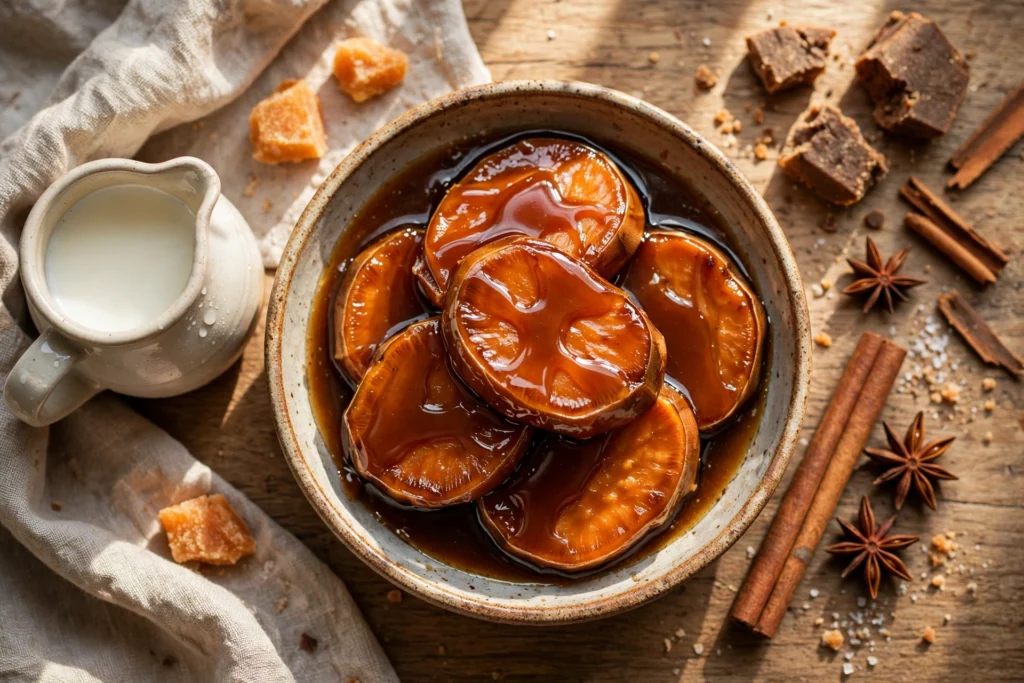
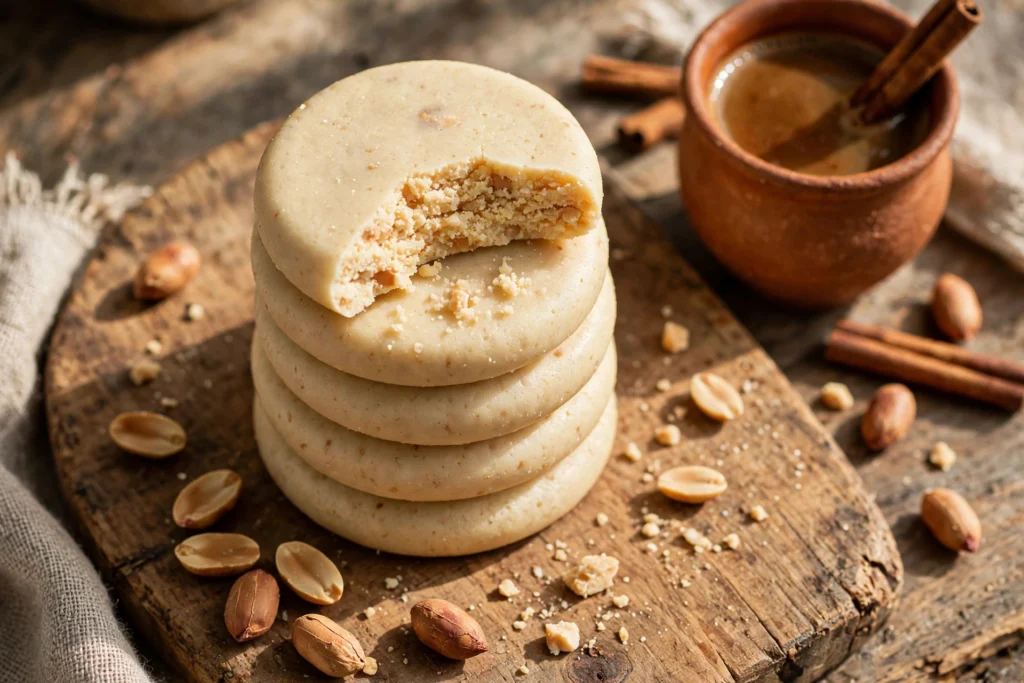
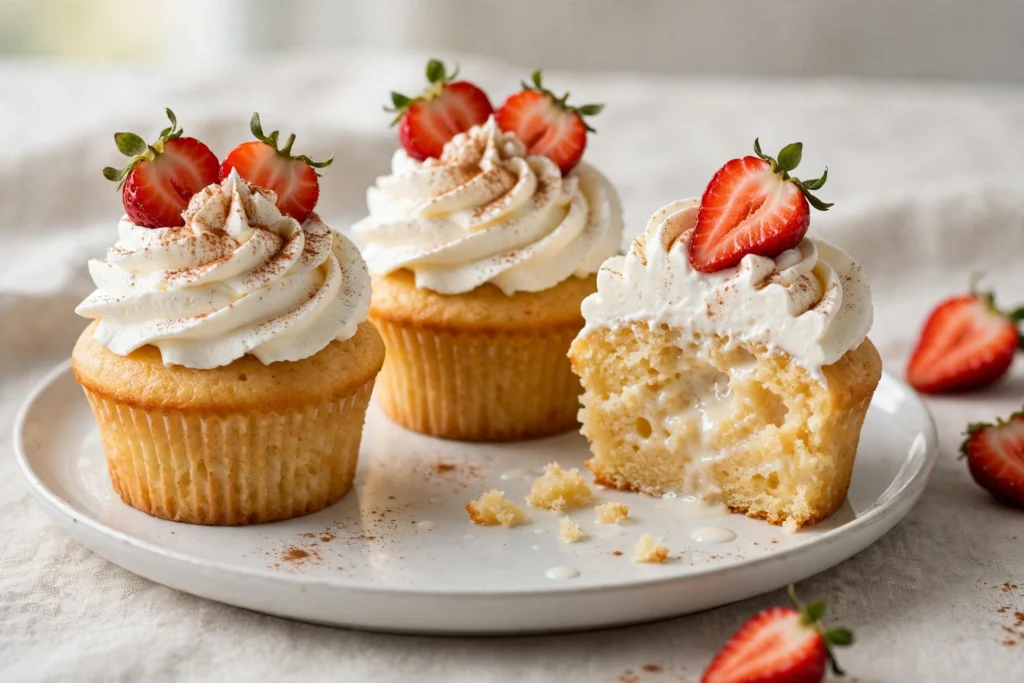
These cookies were made for a Christmas cookie tray, so start there. Set them next to soft, spiced marranitos — the dark crinkles and golden pig-shaped cookies look beautiful side by side. For a party table, add tres leches cupcakes too, because the creamy cupcakes give guests something soft and milky next to the fudgy cookies. Serve with hot cocoa or cold milk. For gift boxes, layer the cookies between parchment sheets so the powdered sugar stays white.
Storage
In an Airtight Container
Store the cooled cookies in an airtight container at room temperature for up to 5 days. They stay soft, and the powdered sugar holds up well while the container stays closed. If the tops look damp after a day or two, dust with fresh powdered sugar. Skip the fridge — it makes the powdered sugar damp.
Freezing the Dough
Scoop and roll the dough into balls, but do not coat them in sugar yet. Freeze the plain balls on a baking sheet until solid, then move them to a freezer bag for up to 3 months. Thaw overnight in the fridge, then roll in both sugars and bake as usual, adding 1 minute to the bake time.
Freezing Baked Cookies
Cool the cookies completely, then stack them in a freezer-safe container with parchment between the layers. Freeze for up to 3 months, thaw at room temperature for about an hour, and dust with fresh powdered sugar before serving, because freezing dulls the white tops.
Frequently Asked Questions
Why didn’t my crinkle cookies crack?
Warm dough is the most common reason. Unchilled dough spreads flat before the sugar coat can split, so the tops stay smooth. Chill the dough for at least 30 minutes, roll the balls thickly in powdered sugar, and bake at 350°F. Stale baking powder is the second most common cause — check the date on the can.
Do I have to chill crinkle cookie dough?
Yes. This dough is soft, almost like brownie batter, and it needs at least 30 minutes in the fridge to firm up enough to roll. Without the chill, it spreads into thin puddles and the crackle never forms. It keeps for up to 24 hours, so mix it the night before and bake it the next day.
Why do you roll crinkle cookies in granulated sugar first?
The granulated sugar keeps the powdered sugar bright white. It clings to the sticky dough and forms a thin, crisp layer, so the fine powdered sugar sits on top instead of soaking in and melting away. That crisp layer is also what cracks open in the oven, giving you the deep dark fissures against the white tops.
Can I make Christmas crinkle cookies ahead of time?
Yes. Mix the dough and keep it in the fridge for up to 24 hours, then roll and bake when ready. Or freeze the uncoated dough balls for up to 3 months, thaw overnight in the fridge, and roll in sugar just before baking. Baked cookies keep for 5 days at room temperature.
How do I keep crinkle cookies soft?
Two things matter: do not overbake them, and store them sealed. Pull the cookies out while the centers still look soft, and let them finish on the hot baking sheet. Then store them in an airtight container at room temperature, with parchment between the layers so they do not stick.
Try These Next
- Monster Cookies — chewy, loaded cookies packed with oats, chocolate chips, and peanut butter.
- Marranitos — soft, spiced Mexican pig-shaped cookies that pair beautifully with chocolate crinkles on a holiday tray.
- Banana Bars — moist banana bars with sweet frosting, perfect for using up ripe bananas after a day of Christmas baking.
- Tres Leches Cupcakes — soft, milky cupcakes soaked in three milks, a creamy contrast to fudgy crinkle cookies.
- Christmas spritz cookies
- Christmas fruitcake
Christmas Crinkle Cookies
Ingredients
The Dry Ingredients
- 1 cup all-purpose flour
- 1/2 cup unsweetened cocoa powder
- 1 teaspoon baking powder
- 1/4 teaspoon salt
The Wet Ingredients
- 1 cup granulated sugar
- 1/4 cup vegetable oil
- 2 large eggs at room temperature
- 1 teaspoon vanilla extract
- 1/2 cup mini chocolate chips
For Rolling
- 1/4 cup granulated sugar
- 3/4 cup powdered sugar
Instructions
- In a large bowl, whisk together the granulated sugar, cocoa powder, and vegetable oil until the mixture forms a thick, dark paste. Add the eggs one at a time, whisking well after each one, then stir in the vanilla extract until the batter is glossy and smooth.

- In a separate bowl, whisk together the flour, baking powder, and salt. Add the dry mixture to the chocolate bowl a little at a time, stirring gently until no dry streaks remain. Fold in the mini chocolate chips. The dough will be soft and sticky, like thick brownie batter.
- Cover the bowl tightly with plastic wrap and refrigerate for 30 minutes, until the dough is firm enough to roll. (The dough keeps in the fridge for up to 24 hours.)
- Preheat the oven to 350°F and line two baking sheets with parchment paper. Put the granulated sugar in one small bowl and the powdered sugar in another. Scoop about 1 1/2 tablespoons of dough per cookie and roll into a smooth ball. Roll each ball first in the granulated sugar, then thickly in the powdered sugar until it looks like a snowball. Place the balls 2 inches apart on the baking sheets.
- Bake for 12 minutes, until the edges are set and the tops have cracked open wide. The centers will still look soft — that is what you want, because they firm up as they cool. Bake one sheet at a time for the most even crackle.
- Let the cookies cool on the baking sheet for 10 minutes, then move them gently to a wire rack to cool completely. Dust with a pinch more powdered sugar while warm if any cookie looks bare.

Notes
- Chill the dough for at least 30 minutes — warm dough spreads flat and the crackle never forms.
- Roll the balls thickly in powdered sugar until they look like snowballs; a light dusting melts away in the oven.
- Keep the dough cold between batches — scoop and roll only one sheet at a time.
- Use fresh baking powder; old baking powder gives a weak rise and a weak crackle.
- Do not overbake — pull the cookies out while the centers still look soft, because they finish on the hot baking sheet.
- Spoon and level the flour; a packed cup makes dry, cakey cookies.
- The dough keeps in the fridge for up to 24 hours, and uncoated dough balls freeze for up to 3 months.
- Store baked cookies in an airtight container at room temperature for up to 5 days; dust with fresh powdered sugar before serving if the tops look damp.