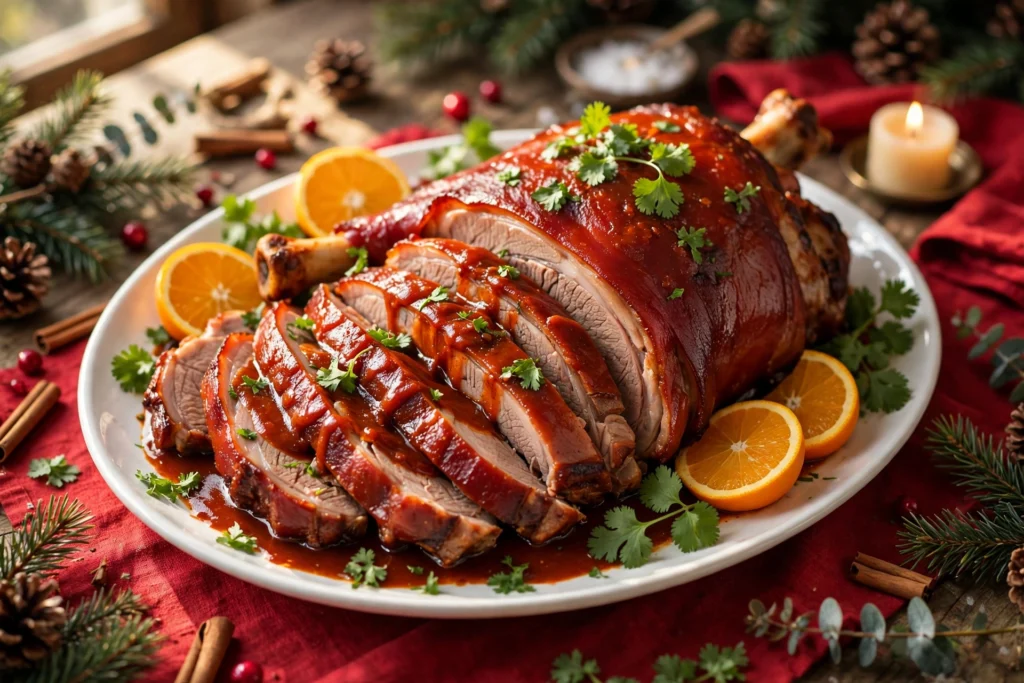
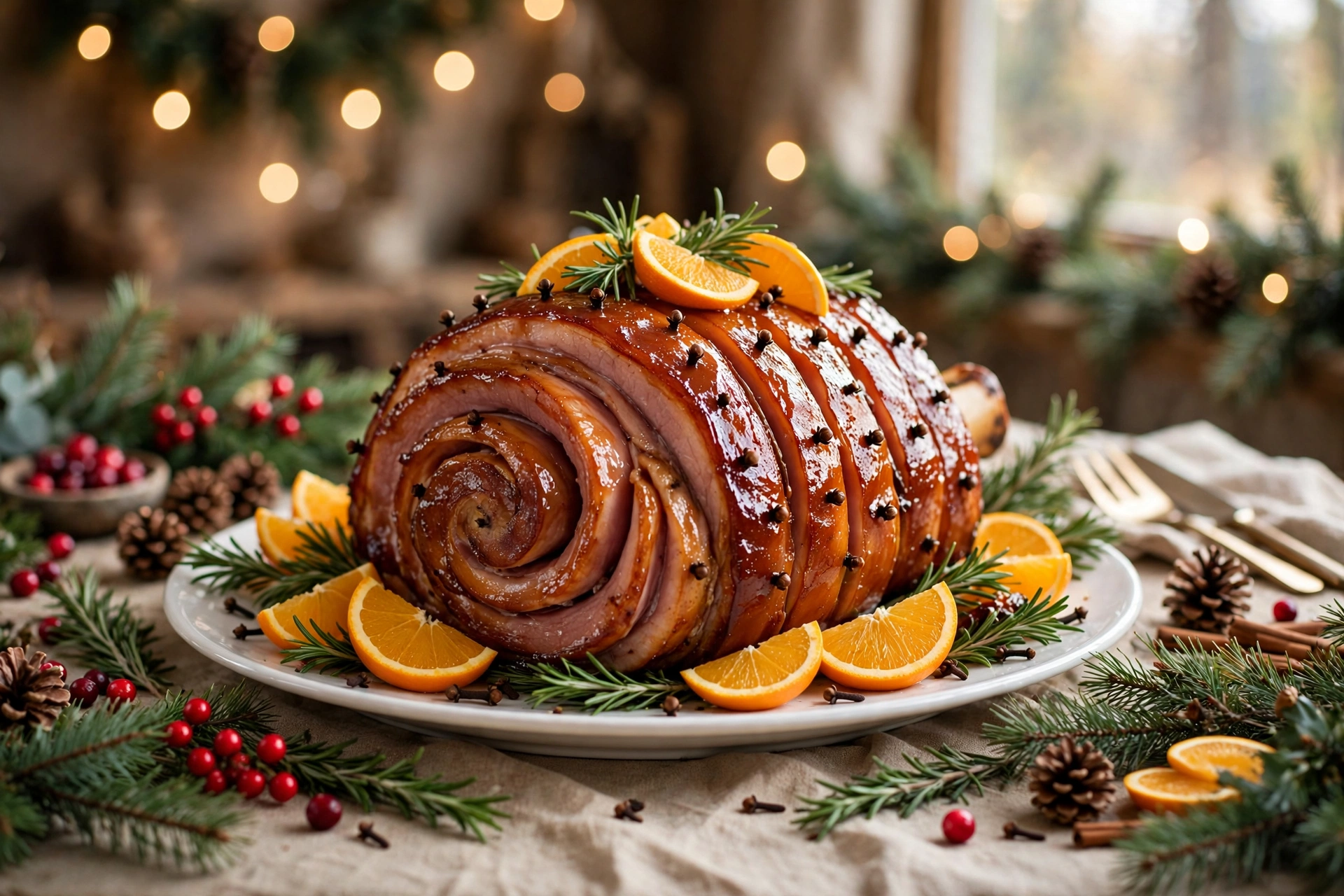
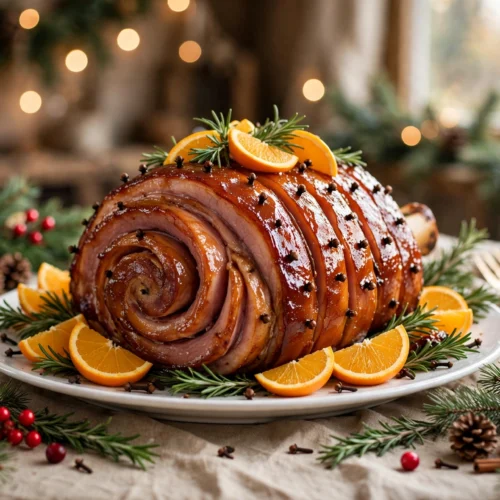
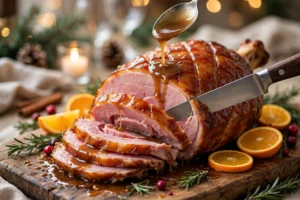
A Christmas ham is the kind of centerpiece that makes the whole table go quiet for a second when it arrives. It is glossy, caramelized at the edges, and it smells like brown sugar, mustard, and warm spices all at once. Then someone cuts the first slice, and the spiral falls open in perfect ribbons.
This Christmas ham takes 15 minutes of hands-on prep and about 2 hours in the oven, and most of that time is hands-off. A fully cooked, bone-in spiral ham warms slowly under foil, then gets two coats of a sticky brown-sugar and mustard glaze in a hot oven. The result is juicy meat inside and a lacquered crust outside.
The best part is that the ham is already cooked when you buy it. You are not cooking raw meat, so there is no guesswork about doneness. Instead, you are simply reheating it gently and glazing it well. That is why this recipe works so reliably.
A Christmas Table Worth Gathering Around

Why You’ll Love It
- Nearly hands-off. The ham spends most of its time in the oven under foil while you finish the sides.
- Juicy, never dry. The covered warm-up and the 140°F finish protect the spiral slices from drying out.
- A sticky, caramelized glaze. Brown sugar, honey, and Dijon build a sweet-savory crust that clings to every slice.
- Feeds a crowd. One 8-pound ham serves 10 generously, with leftovers for sandwiches.
- Foolproof for beginners. The ham is already fully cooked, so you are reheating it, not cooking raw meat.
- Make-ahead friendly. The glaze can be made up to 5 days ahead.
- The leftovers are a gift. Sliced ham becomes sandwiches, soup, and breakfast hash all week.
Ingredients
For the Ham
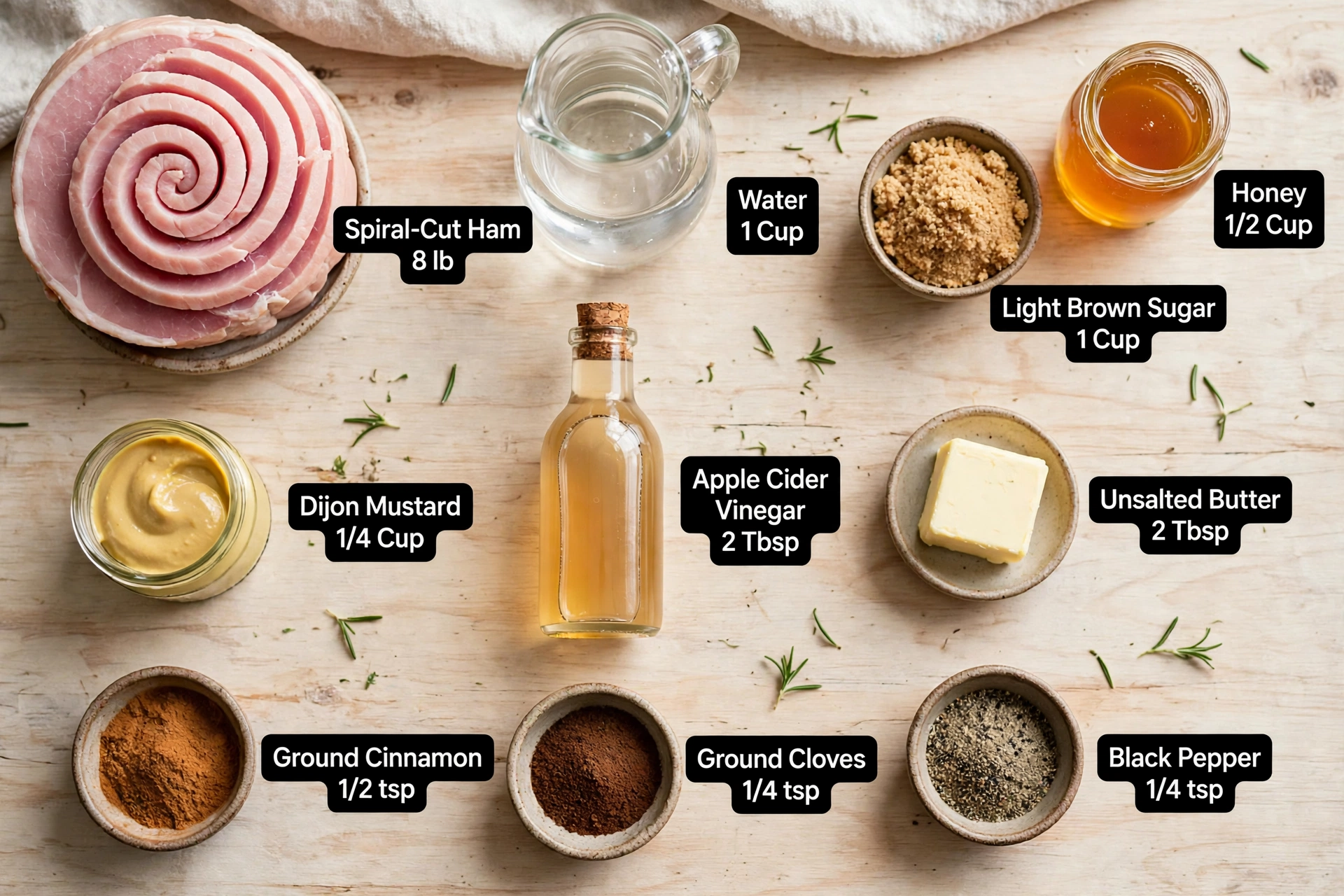
- 1 fully cooked bone-in spiral-cut ham (8 pounds) — The star of the show. A spiral-cut ham is already sliced around the bone, so serving is easy and the glaze seeps between the slices. Bone-in hams stay juicier than boneless ones because the bone insulates the meat. Substitution: a 7- to 9-pound fully cooked bone-in spiral ham — adjust the time using the table below.
- 1 cup water — The steam insurance in the roasting pan. It turns to steam under the foil and keeps the thin spiral slices moist while the ham warms through. Substitution: 1 cup apple juice, or 1 cup low-sodium chicken broth.
For the Brown Sugar Mustard Glaze
- 1 cup packed light brown sugar — The body and caramel flavor of the glaze. It melts into a syrup that thickens as it simmers, and its molasses notes give the glaze its deep amber color. Substitution: 1 cup packed dark brown sugar.
- 1/2 cup honey — Shine and cling. Honey makes the glaze glossy and helps it stick to the ham. Substitution: 1/2 cup maple syrup.
- 1/4 cup Dijon mustard — The savory balance. Mustard keeps the glaze from tasting like candy: its sharp tang cuts through the sugar and honey. Substitution: 1/4 cup whole grain mustard.
- 2 tablespoons apple cider vinegar — Brightness. Vinegar wakes the glaze up and thins it just enough to brush between the slices. Substitution: 2 tablespoons pineapple juice.
- 2 tablespoons unsalted butter — Richness and a silky finish. Butter rounds out the sharp edges of the mustard and vinegar. Unsalted is best because ham is already salty. Substitution: 2 tablespoons salted butter.
- 1/2 teaspoon ground cinnamon — Warmth. You will not taste it outright, but you will notice the warmth it adds. Substitution: 1/2 teaspoon pumpkin pie spice.
- 1/4 teaspoon ground cloves — The classic ham spice. Its warm, almost floral flavor suits cured pork, but a little goes a long way, so measure carefully. Substitution: 1/8 teaspoon ground allspice.
- 1/4 teaspoon black pepper, freshly ground — A small bite at the finish. Pepper adds a gentle heat that balances the sugar. Substitution: 1/4 teaspoon white pepper.
How to Make Christmas Ham
1Step 1: Place the Ham in the Pan
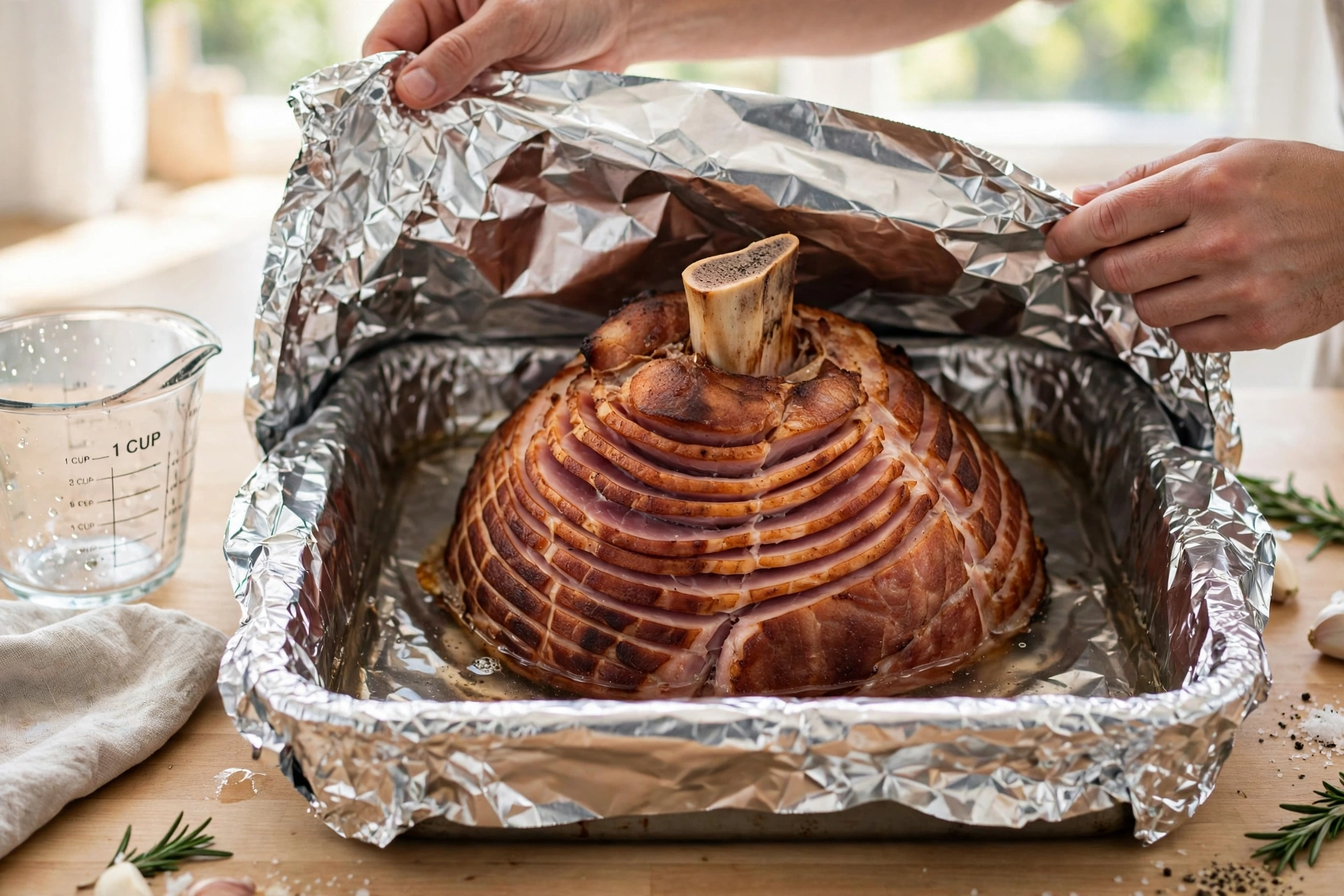
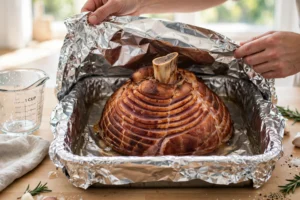
Place the ham in the pan. Heat the oven to 325°F with a rack in the lower third. Unwrap the ham and throw away any glaze packet that came with it. Set the ham cut-side down in a deep roasting pan, pour 1 cup of water around it, and cover tightly with foil, crimping the edges so no steam escapes.
2Step 2: Bake Covered Until 120°F
Bake covered until 120°F. Bake for 10 to 12 minutes per pound, until a thermometer in the thickest part — away from the bone — reads 120°F. For an 8-pound ham, that takes about 1 hour and 35 minutes. Do not rush: the low, covered heat warms the ham evenly without drying the thin slices.
3Step 3: Make the Glaze
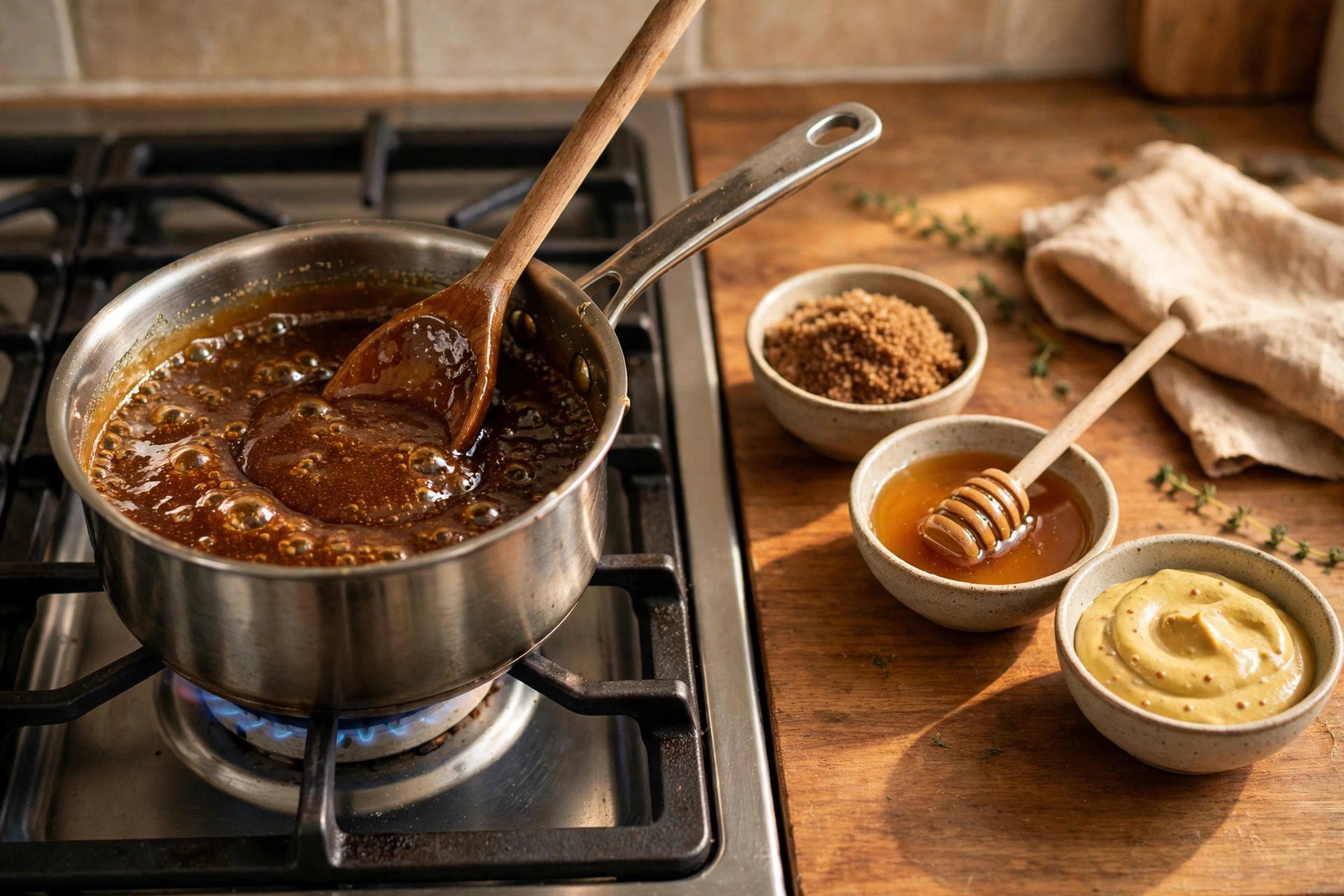
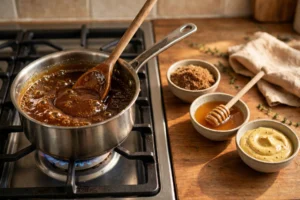
Make the glaze. While the ham bakes, put the brown sugar, honey, Dijon mustard, apple cider vinegar, butter, cinnamon, cloves, and black pepper in a small saucepan. Stir over medium heat until the sugar dissolves, then simmer gently for 3 to 5 minutes, until the glaze turns syrupy.
4Step 4: Glaze and Finish at 400°F
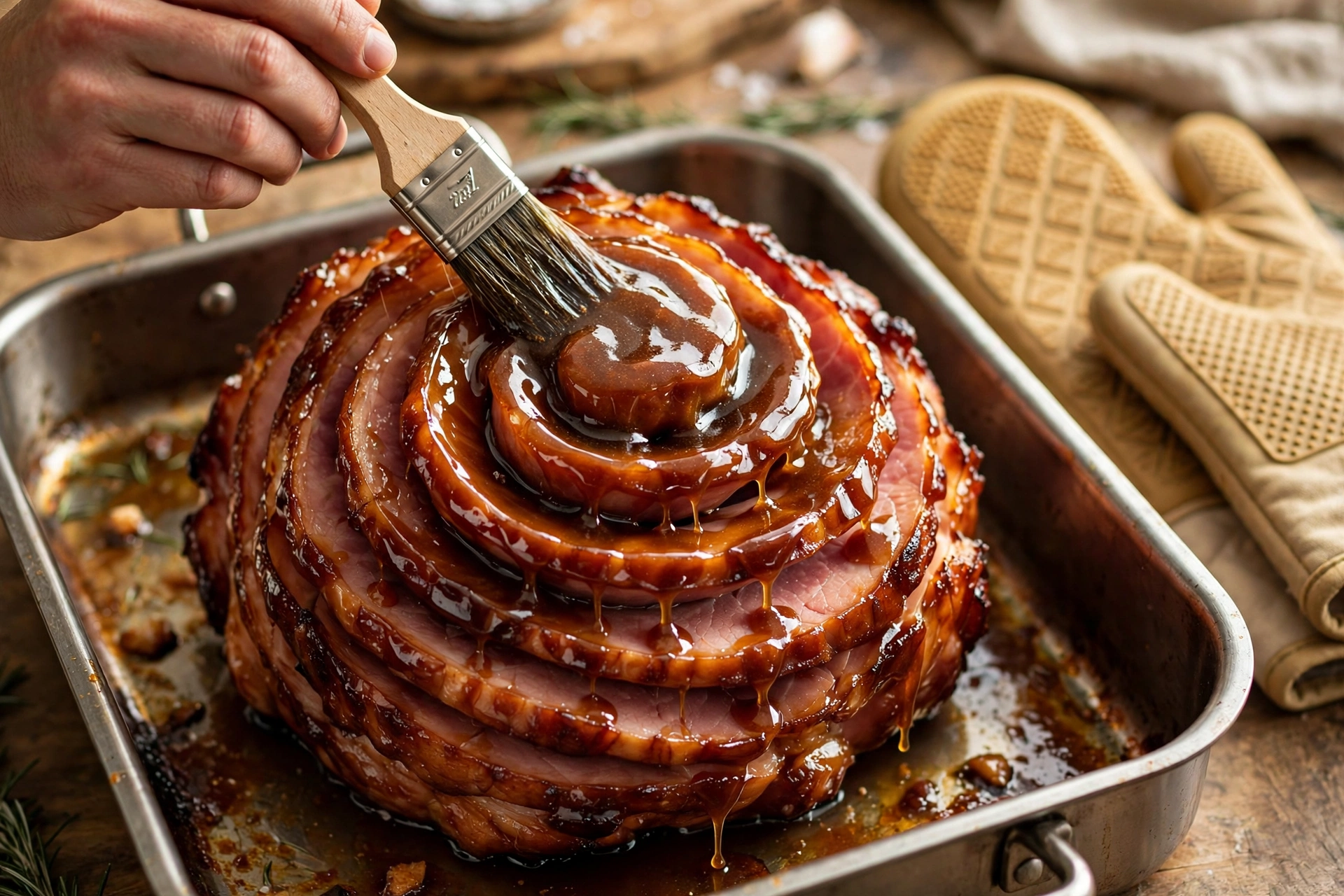
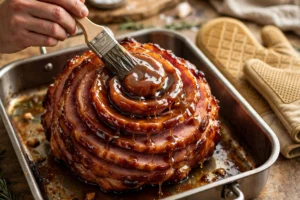
Glaze and finish at 400°F. Pull the ham out and turn the oven up to 400°F. Remove the foil and brush half the glaze all over the ham, working it down between the spiral slices. Return the ham to the oven, uncovered, and bake for 10 minutes so the first coat sets.
5Step 5: Add the Second Coat
Add the second coat. Brush the rest of the glaze over the ham and bake for 10 to 15 minutes more, until the glaze is bubbling and browned at the edges and the center reads 140°F. Watch it closely near the end, because sugar burns fast.
6Step 6: Rest and Carve
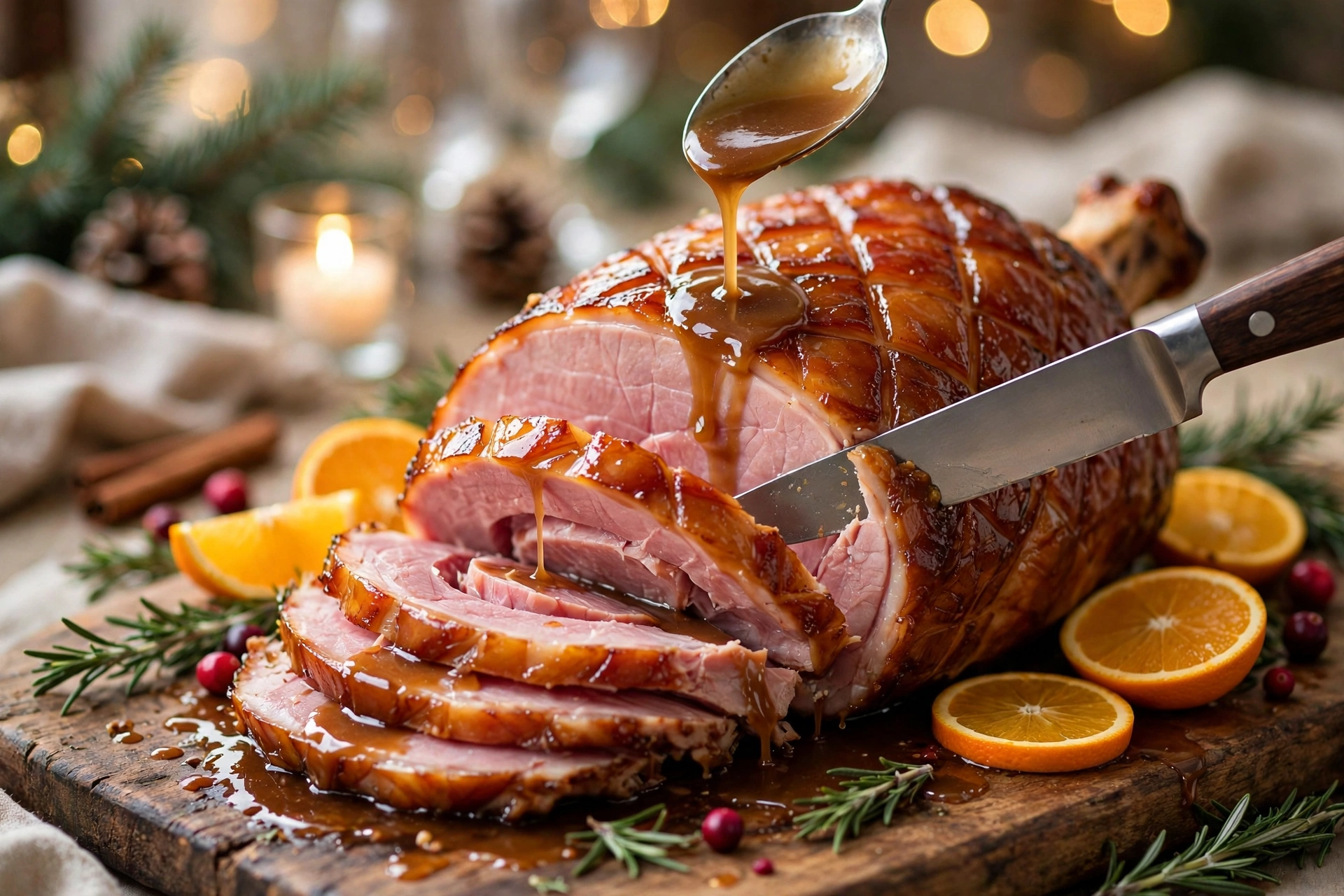
Rest and carve. Brush the ham once more with any glaze left in the pan, then cover loosely with foil and rest for 15 minutes, so the juices settle back into the meat. To carve, run a long knife along the bone to free the slices, then spoon the warm pan juices over the top.
Technique: The Glaze System and the Spiral-Ham Heating Method
A Christmas ham fails in exactly two ways: it dries out, or the glaze burns. This method prevents both with a simple idea — keep the heating and the glazing separate. First, the ham warms slowly under foil. Then the glaze goes on in a hot oven.
The Temperature Ladder: 120°F, Then 140°F
A spiral ham is already fully cooked, so your only job is to reheat it to 140°F in the center. First, the ham bakes covered at 325°F until it reaches 120°F, so it is hot through but still has 20 degrees of headroom. Then the uncovered glaze stage carries it the last 20 degrees to 140°F. Trust a thermometer, not a timer: push it into the thickest part, away from the bone. Anything past 145°F is where spiral ham starts to dry out.
Why Covered Baking Matters
Spiral slices have far more exposed surface than a whole ham, and exposed surface dries out fast in a hot oven. A tight foil cover traps the steam from the cup of water in the pan, and that steam bathes the slices in moisture for the whole warm-up. Without it, the outer slices turn leathery. So crimp the foil firmly, and do not peek during the first hour.
The Two-Coat Glaze System
Sugar burns, so the glaze only goes on at the end, and it goes on in two coats. The first coat soaks into the warm slices, fills the spiral gaps, and starts to caramelize in the 400°F oven. The second coat sits on top of the first, bubbles, and turns into the glossy, sticky crust on the platter. If you put all the glaze on at once, the outer layer would burn before the inner layer set.
The Per-Pound Timing Table
Cooking time depends on weight, not on guesswork, so use this table as your starting point and confirm with a thermometer. All times are at 325°F, covered, before the 20- to 25-minute uncovered glaze stage.
| Ham weight | Covered bake time | Total time with glazing |
|---|---|---|
| 5 pounds | 50–60 minutes | About 1 hour 20 minutes |
| 7 pounds | 1 hour 10–1 hour 25 minutes | About 1 hour 45 minutes |
| 8 pounds | 1 hour 35–1 hour 40 minutes | About 2 hours |
| 10 pounds | 2 hours–2 hours 5 minutes | About 2 hours 30 minutes |
Start checking about 15 minutes before the earliest time in the range, and pull the ham from the covered stage at 120°F. If your ham is boneless, check it even earlier.
Tips for the Best Christmas Ham
- Buy fully cooked, bone-in, spiral-cut. Fully cooked means reheating only, bone-in means juicier meat, and spiral-cut means easy serving.
- Throw away the glaze packet. The packet glaze is thin and overly sweet, and this homemade glaze is better in every way.
- Keep the foil tight. Crimp it firmly so the steam stays in — loose foil is the most common cause of dry ham.
- Glaze only at the end. Sugar burns, so the glaze goes on for the last 20 to 25 minutes and never before.
- Use a thermometer, not a timer. Pull the ham at 140°F in the center, away from the bone.
- Rest for 15 minutes. The juices redistribute during the rest, so slices cut too soon weep moisture onto the board.
- Save the bone. A leftover ham bone makes wonderful soup stock, so wrap it and freeze it.
- Rescue a dry ham. If the ham goes past 145°F, slice it and warm the slices in a covered dish with 1/2 cup of apple juice or broth at 325°F for 20 minutes.
Variations
Pineapple Christmas Ham
Swap the apple cider vinegar for 1/4 cup pineapple juice and stud the ham with whole cloves in a diamond pattern before glazing.
Maple Mustard Christmas Ham
Replace the honey with 1/2 cup pure maple syrup and use dark brown sugar instead of light, for a darker, more caramel-like glaze.
Spicy Christmas Ham
Add 1/2 teaspoon cayenne pepper and 1 tablespoon of hot sauce to the glaze, and use spicy brown mustard in place of Dijon.
Slow Cooker Christmas Ham
For a 5- to 6-pound ham, place it in a large slow cooker with 1/2 cup water, pour half the glaze over it, and cook on LOW for 3 to 4 hours until the center reads 140°F. Then brush on the rest of the glaze and finish under the broiler for 3 to 5 minutes, watching closely.
What to Serve With Christmas Ham
A Christmas ham loves sides that are sweet, bright, or buttery, because they echo the glaze without competing with it. Start with honey glazed carrots — their gentle sweetness sits beautifully next to the ham. Then add cranberry sauce for a tart, ruby-bright contrast that cuts through the richness of the meat. If the table needs a second main, a roast turkey breast gives guests a choice at the same oven temperature. For a smaller gathering, slow cooker turkey breast keeps the turkey out of the oven entirely.
Storage
In the Fridge
Store leftover Christmas ham in an airtight container or wrapped tightly in foil in the fridge for up to 4 days. Slice it before storing, because sliced ham is far easier to use in sandwiches and quick meals. Pour any leftover pan juices over the slices first.
In the Freezer
Freeze sliced ham in freezer bags, with as much air pressed out as possible, for up to 2 months. Label each bag with the date and amount. Thaw overnight in the fridge, and warm the slices gently in a covered dish with a splash of broth.
The Leftover Plan
One 8-pound ham leaves plenty for the days after Christmas. On day one, make ham sandwiches on soft rolls with mustard and pickles. On day two, dice the ham into a split pea or bean soup with the saved ham bone. On day three, fold diced ham into scrambled eggs or a breakfast hash. Freeze any remaining ham in one-cup portions for busy January nights.
Frequently Asked Questions
How do you cook a ham for Christmas?
Buy a fully cooked bone-in spiral-cut ham, place it cut-side down in a roasting pan with 1 cup of water, cover tightly with foil, and bake at 325°F for 10 to 12 minutes per pound until the center reads 120°F. Then brush on a brown-sugar and mustard glaze in two coats and bake uncovered at 400°F for 20 to 25 minutes, until the glaze is caramelized and the center reads 140°F. Rest 15 minutes before carving.
How long do you cook a spiral ham per pound?
A fully cooked spiral ham needs 10 to 12 minutes per pound at 325°F, covered with foil, to reach 120°F in the center. An 8-pound ham takes about 1 hour and 35 minutes covered, plus 20 to 25 minutes uncovered for glazing — about 2 hours in total. Confirm with a meat thermometer, because ovens vary.
What temperature should Christmas ham reach?
A fully cooked Christmas ham should reach 140°F in the thickest part, measured away from the bone. That is the safe reheating temperature, and the point where the ham is hot all the way through but still juicy. If the label says “cook before eating,” the ham must reach 145°F and rest for 3 minutes.
Should you cover a ham while baking?
Yes. Cover the ham tightly with foil for the whole warm-up stage, until it reaches 120°F. The foil traps steam from the water in the pan and keeps the thin spiral slices moist. Only remove the foil for the final glazing stage, when the uncovered heat caramelizes the glaze.
Can you make Christmas ham ahead of time?
Yes, in two ways. First, the glaze can be made up to 5 days ahead and kept in a jar in the fridge — warm it gently before brushing it on. Second, the whole ham can be baked a day ahead, cooled, sliced, and stored in the fridge, then reheated in a covered dish with 1/2 cup of apple juice or broth at 325°F for 20 minutes.
How much ham do you need per person?
Plan on about 3/4 pound of bone-in ham per person, which leaves room for seconds and leftovers. An 8-pound bone-in spiral ham therefore serves about 10 people generously. If the ham is boneless, plan on about 1/2 pound per person. When in doubt, buy a little more — leftover ham is never a problem.
Try These Next
- Roast Turkey Breast — a juicy roast turkey breast that shares the oven with a Christmas ham.
- Slow Cooker Turkey Breast — a hands-off turkey breast that frees the oven for the ham.
- Honey Glazed Carrots — sweet, glossy carrots for every Christmas plate next to the ham.
- Cranberry Sauce — tart, bright cranberry sauce that cuts through the ham’s rich glaze.
- Christmas enchiladas
- Christmas mince pies
Christmas Ham
Ingredients
For the Ham
- 1 fully cooked bone-in spiral-cut ham 8 pounds
- 1 cup water
For the Brown Sugar Mustard Glaze
- 1 cup packed light brown sugar
- 1/2 cup honey
- 1/4 cup Dijon mustard
- 2 tablespoons apple cider vinegar
- 2 tablespoons unsalted butter
- 1/2 teaspoon ground cinnamon
- 1/4 teaspoon ground cloves
- 1/4 teaspoon black pepper
Instructions
- Heat the oven to 325°F and set a rack in the lower third. Place the ham cut-side down in a deep roasting pan, pour 1 cup of water around it, and cover the pan tightly with heavy-duty foil.

- Bake for 10 to 12 minutes per pound, until a thermometer in the thickest part (away from the bone) reads 120°F — about 1 hour 35 minutes for an 8-pound ham.
- While the ham bakes, combine the brown sugar, honey, Dijon mustard, apple cider vinegar, butter, cinnamon, cloves, and black pepper in a small saucepan. Simmer over medium heat, stirring, for 3 to 5 minutes until syrupy. Remove from the heat.
- Remove the ham from the oven and raise the oven temperature to 400°F. Uncover the ham and brush half the glaze all over it, working it down between the spiral slices. Bake uncovered for 10 minutes.
- Brush the remaining glaze over the ham and bake 10 to 15 minutes more, until the glaze is bubbling and browned at the edges and the center reads 140°F.
- Remove the ham from the oven and brush with any remaining glaze. Cover loosely with foil and rest for 15 minutes. Run a knife along the bone to free the slices, then spoon the pan juices over the top and serve.
Notes
- Buy a ham labeled "fully cooked" — this recipe reheats a cooked ham; a ham labeled "cook before eating" must reach 145°F and rest 3 minutes.
- Keep the foil tight during the covered bake; loose foil lets the steam escape and dries the spiral slices.
- Glaze only in the last 20 to 25 minutes — sugar burns fast, so never glaze a ham at the start of baking.
- Pull the ham at 140°F in the center, away from the bone; past 145°F a spiral ham dries out quickly.
- Rest the ham for 15 minutes before carving so the juices settle and the slices stay moist.
- The glaze can be made up to 5 days ahead and kept in a jar in the fridge; warm it gently before using.
- Save the ham bone for soup stock — wrap it and freeze it for up to 2 months.
- Store leftover sliced ham in the fridge for up to 4 days, or freeze it for up to 2 months; reheat gently with a splash of broth.