
A Cheesecake That Is Meant to Look Burnt
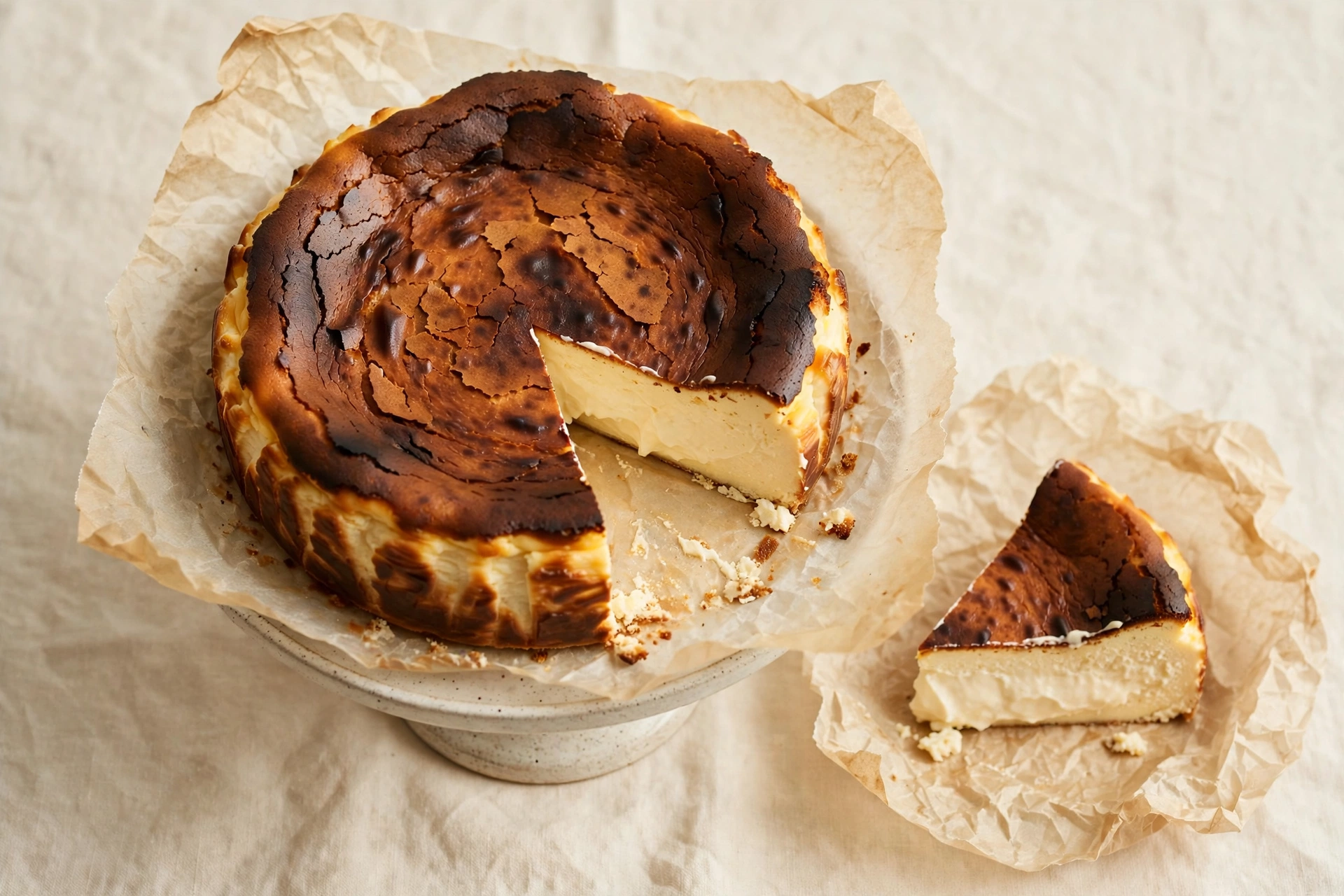
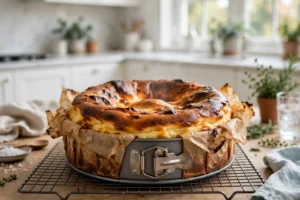
The first time you pull a Basque cheesecake out of the oven, your instinct will be to panic. The top is dark, deeply golden, almost burnt. The middle wobbles like jelly. And the whole cake has puffed up like a soufflé, far above the rim of the pan.
Take a breath. That is exactly what a good Basque cheesecake is supposed to look like.
This easy basque cheesecake recipe gives you a cake that tastes like crème caramel met a vanilla cheesecake: a dark, toasty, caramel-flavoured top over a centre so creamy it almost melts on your tongue. There is no crust, no water bath, and no springform-pan leak to worry about. You stir together just seven ingredients, pour the batter into a parchment-lined pan, and let a hot oven do the work.
Hands-on time is only about 20 minutes, plus around 50 minutes in the oven and a long, patient chill in the fridge. That chill is the hardest part, because the whole house will smell wonderful. But a properly chilled Basque cheesecake slices cleanly and tastes even better the next day.
Why You’ll Love It
- No crust, no water bath, no fuss. This is the most forgiving cheesecake you will ever bake.
- Just 7 ingredients. Cream cheese, sugar, eggs, cream, flour, vanilla and salt — nothing fancy, nothing hard to find.
- That famous burnt top. The deep golden surface tastes like caramel, and it forms all on its own in a hot oven.
- A creamy, almost custardy centre. The inside stays soft and light, nothing like a dense New York-style cheesecake.
- Make-ahead friendly. In fact, it tastes better after a night in the fridge, so it is perfect for parties.
- Beginner proof. If you can beat cream cheese smooth and watch a timer, you can make this cake.
- Endlessly adaptable. Chocolate, matcha, pumpkin spice, citrus — the base recipe welcomes all of them.
Ingredients
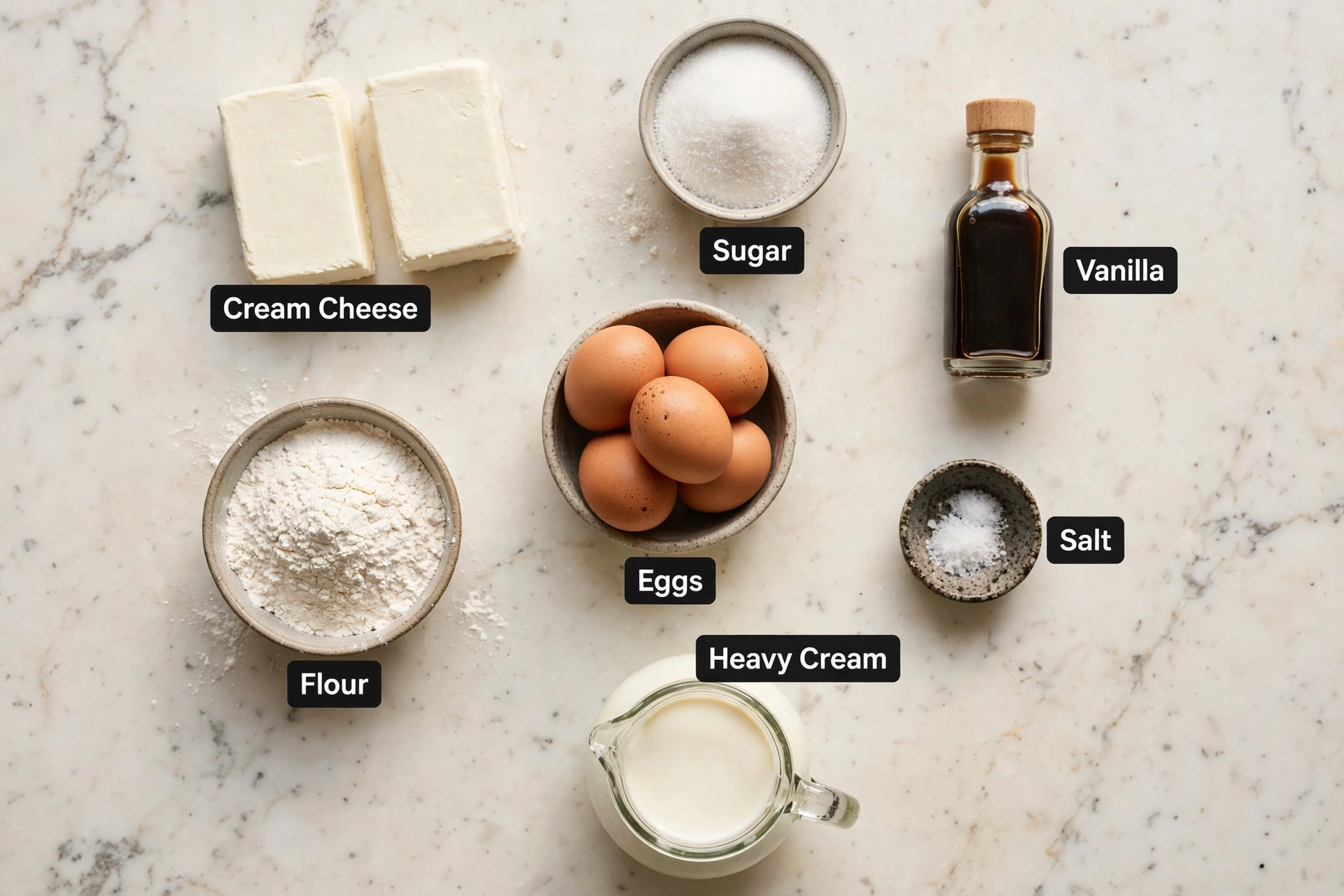
- 32 oz full-fat cream cheese (4 blocks), room temperature — This is the heart of the cake, so use the block kind, not the tub. Full-fat cream cheese sets properly and gives the cake its rich, tangy flavour. Low-fat cream cheese will not set the same way, so skip it here. Take the blocks out of the fridge at least an hour before you start; soft cream cheese beats smooth without lumps. Substitution: any full-fat block cream cheese works, including store brands.
- 1 1/2 cups granulated sugar — Sugar sweetens the cake, of course, but it also helps the top caramelise into that deep golden colour. Regular white sugar is perfect here. Substitution: caster or superfine sugar dissolves a little faster, so use it if you have it; do not use brown sugar, as it changes the flavour and the colour.
- 5 large eggs + 1 large egg yolk, room temperature — The eggs set the filling and give it a soft, custardy texture. The extra yolk adds richness and a gentle golden colour to the crumb. Room-temperature eggs blend in smoothly, so set them in a bowl of warm water for 10 minutes if you forgot to take them out. Substitution: if your eggs are small, use 6 whole eggs instead of 5 plus a yolk.
- 1 1/4 cups heavy whipping cream — Cream thins the batter just enough to make the centre silky instead of heavy. It must be cream that can be whipped — check the label, because pouring cream will not give the same result. Substitution: heavy cream is best; whipping cream with at least 35% fat also works. Do not use half-and-half or milk.
- 1/4 cup all-purpose flour — Just a small amount of flour steadies the filling so the cake holds its shape after baking while staying light. Too much flour would dry it out, so measure carefully and level the cup. Substitution: a 1-to-1 gluten-free flour blend works in the same amount.
- 2 teaspoons vanilla extract — Vanilla rounds out the tang of the cream cheese and gives the cake its warm, dessert-shop flavour. Real vanilla extract or vanilla bean paste both work beautifully. Substitution: imitation vanilla will do in a pinch, but the flavour is noticeably flatter.
- 1 teaspoon fine salt — Salt might seem like a small detail, but it sharpens every other flavour in the cake and keeps the sweetness from tasting flat. Do not leave it out. Substitution: if you only have kosher salt, use 1 1/4 teaspoons.
- 1 tablespoon granulated sugar, for dusting (optional) — A light dusting over the top before baking helps the surface brown even more evenly. It is optional, but it is a nice trick if your oven browns unevenly.
How to Make Basque Cheesecake
Follow the steps below in order, and read the Technique section before you start if this is your first Basque cheesecake. The whole method is simple, but the order matters: smooth cream cheese first, then sugar, then eggs, then cream and flour.
Step 1 — Line the Pan
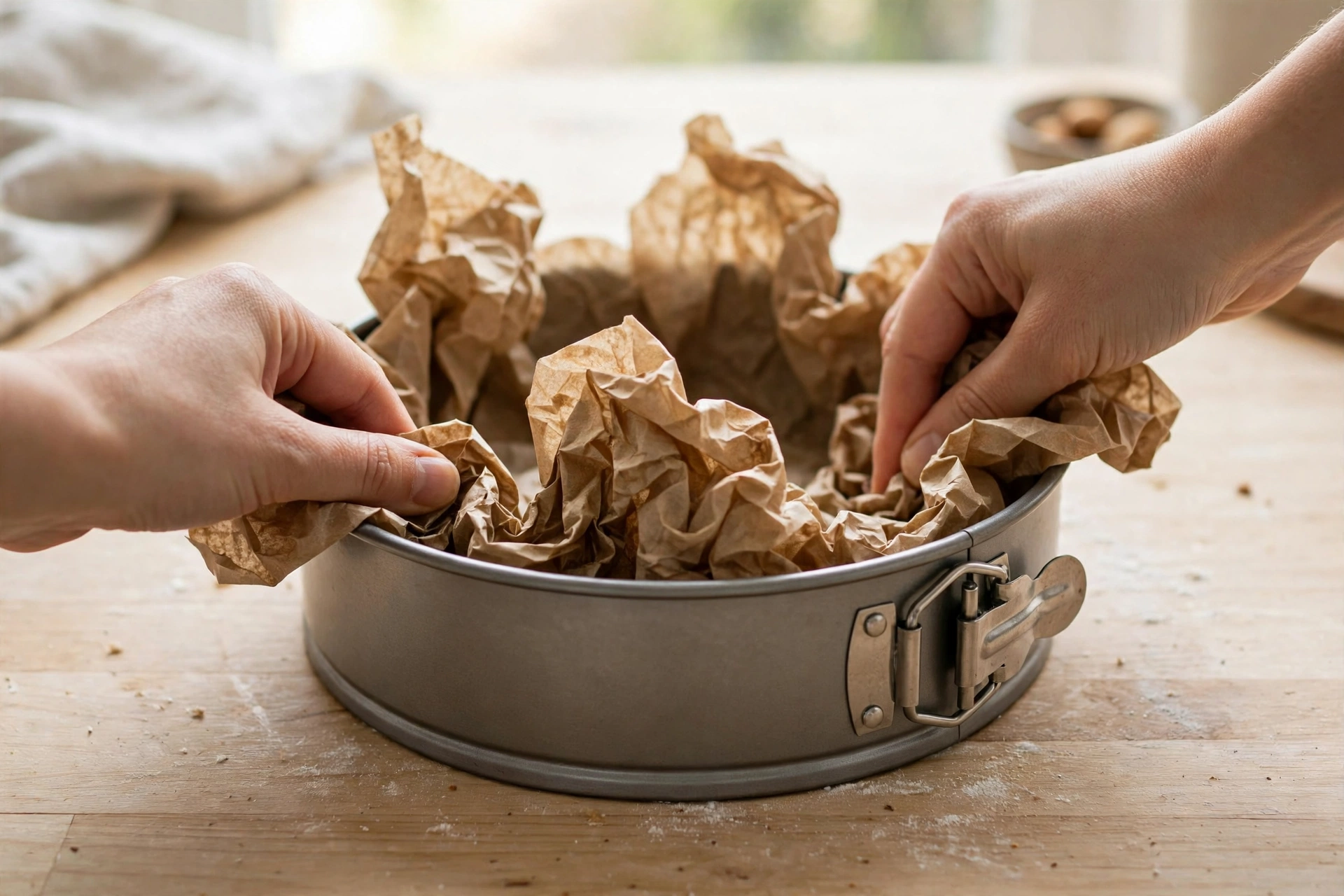
Line the pan with scrunched parchment.
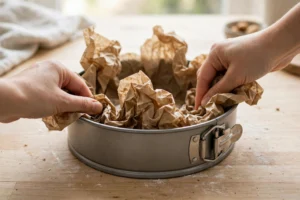
Take two large sheets of parchment paper and scrunch each one into a tight ball in your hands. Then open them back out and press them into a 9-inch springform pan in a cross shape, so the paper rises about 2 inches above the rim. The wrinkles are the point — they create the cake’s famous rustic, ruffled sides. Do not grease the pan first; the batter will hold the paper down.
Step 2 — Beat the Cream Cheese and Sugar
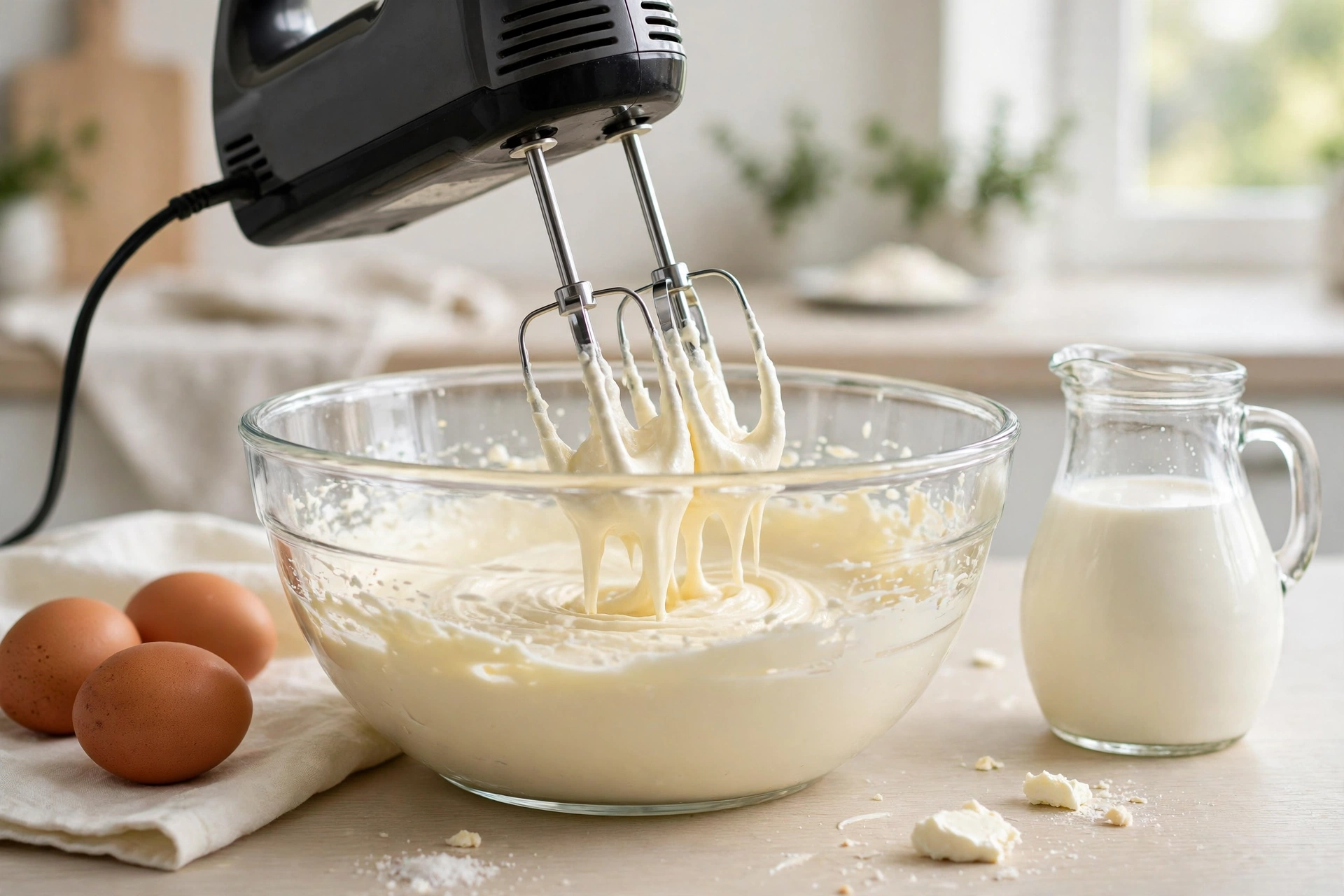
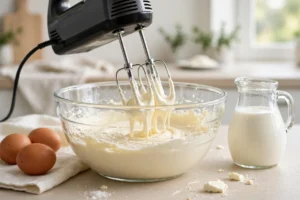
Beat until completely smooth.
Put the room-temperature cream cheese in a large bowl and beat it with a hand mixer or a stand mixer fitted with the paddle attachment on medium speed for about 2 minutes. Scrape down the sides of the bowl once or twice. When the cream cheese is smooth and lump-free, add the sugar and beat on low for just 10 seconds, until it disappears into the cheese.
Step 3 — Add the Eggs, Cream and Flour
Add the eggs one at a time.
With the mixer on low, add the eggs one at a time, beating briefly after each one. Then add the extra yolk and the vanilla. In a separate small bowl, whisk the flour with about 1/4 cup of the cream into a smooth, lump-free paste. Whisk in the rest of the cream, then pour the cream mixture into the cream cheese bowl in a slow stream while the mixer runs on low. Stop as soon as everything is combined — overbeating whips air into the batter and leaves bubbles on the finished top.
Step 4 — Pour and Bake
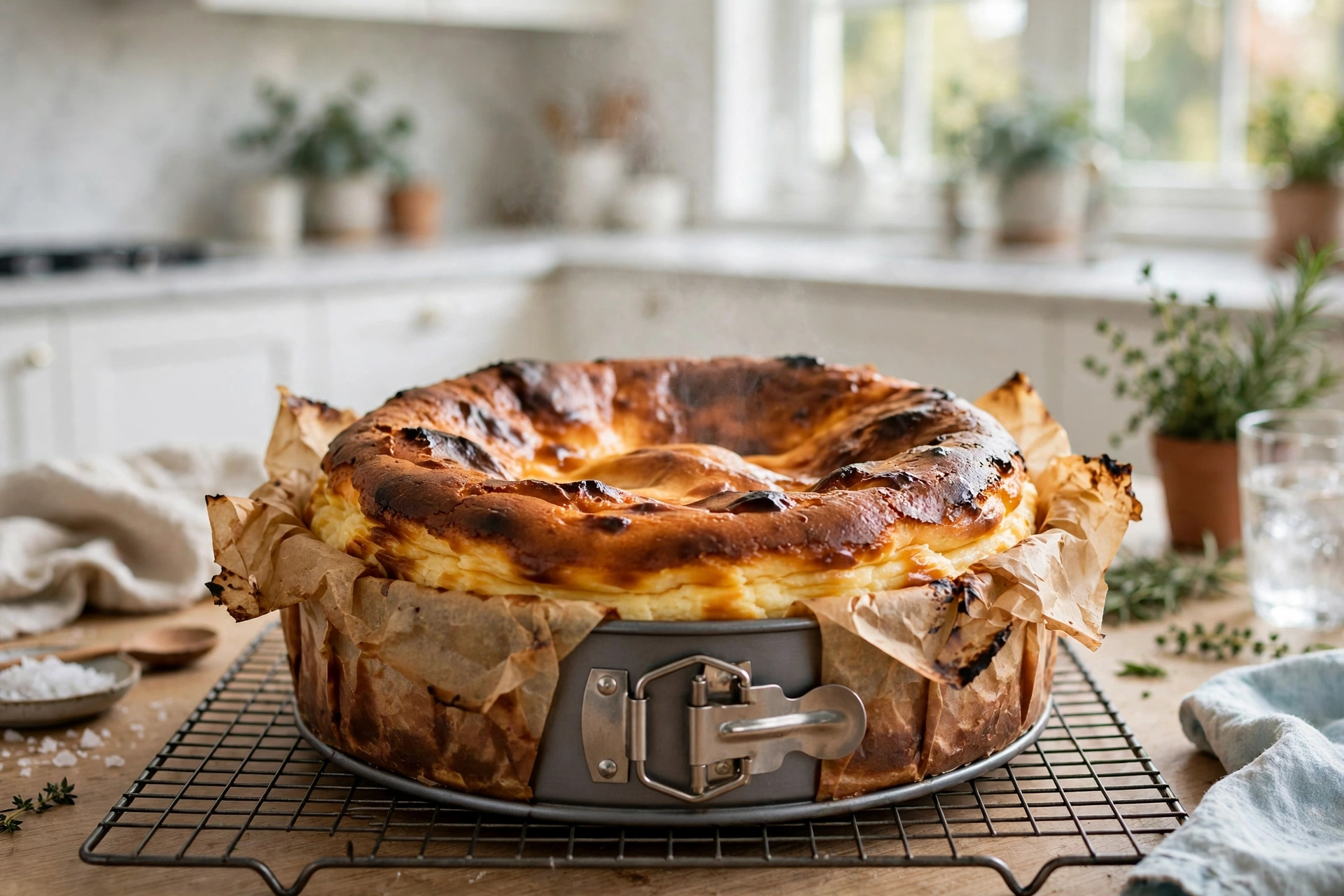
Bake at 425°F until deeply golden.
Pour the batter into the lined pan and tap the pan firmly on the counter two or three times to bring air bubbles to the surface. Pop any bubbles you see with the tip of a knife. Bake in a preheated 425°F (220°C) oven, on the middle rack, for 45 to 55 minutes. The top should turn a deep golden brown — darker than you expect — while the centre still wobbles like soft jelly when you gently shake the pan. That wobble is correct. If the centre does not move at all, the cake is overbaked.
Step 5 — Cool on the Counter
Let it fall — that is normal.
Take the pan out of the oven and set it on a wire rack. As the cake cools, it will sink and settle, sometimes leaving a shallow dip in the middle. That is completely normal. Leave it in the pan on the counter for at least 2 hours, until it is no longer warm to the touch.
Step 6 — Chill Overnight and Slice
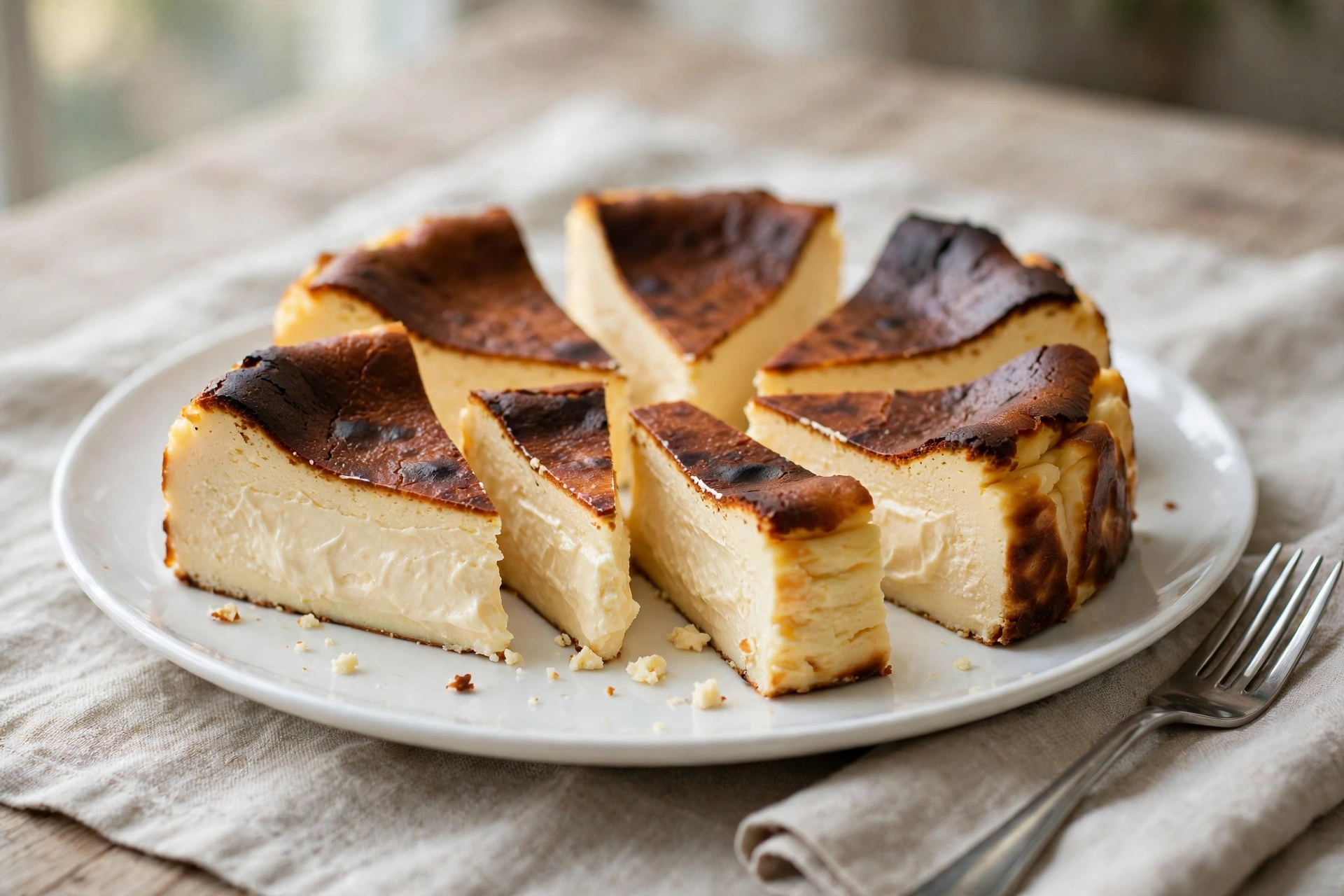
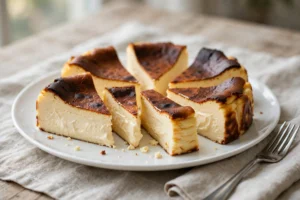
Chill uncovered, then slice cleanly.
Move the pan to the fridge, uncovered, and chill for at least 8 hours — overnight is best. Chilling uncovered keeps condensation from dripping onto the beautiful browned top. When you are ready to serve, release the springform sides and peel the parchment away from the edges. For neat slices, use a long, sharp knife and wipe the blade clean between each cut.
Technique: Lining the Pan with Scrunched Parchment
If there is one step that separates a great Basque cheesecake from a disappointing one, it is the parchment. A traditional cheesecake pan lining — smooth, flat strips of paper pressed neatly against the sides — will give you a smooth-sided cake with a thick band of dry, overcooked cheesecake around the edges. That is the opposite of what you want here.
The scrunched paper does two jobs at once. Its wrinkles hold the paper slightly away from the pan walls, so the sides bake gently and stay creamy instead of drying out. They also press into the batter as it rises, creating the cake’s signature ruffled edge.
So do not be shy with the scrunching. Crumple each sheet hard, then open it out and press it into the pan, folding the excess over the rim. Use two sheets in a cross, because one sheet rarely covers a 9-inch pan with enough overhang. The paper will look messy, and that is fine. A messy lining is a correct lining. When the cake is baked and chilled, the paper peels away to reveal those beautiful nubbly sides.
Use real parchment or baking paper, not wax paper — wax paper melts and sticks in a 425°F oven. If your sheets are small, overlap two of them before you scrunch.
Tips for the Best Basque Cheesecake
Tips for Success
- ✔ Start with room-temperature ingredients. Cold cream cheese makes lumps, and cold eggs do not blend smoothly. Give everything an hour on the counter first.
- ✔ Trust the wobble. The centre should jiggle like soft jelly when the cake comes out. It firms up in the fridge. A fully set centre in the oven means a dry cake.
- ✔ Watch the last 15 minutes. The line between deeply golden and actually burnt is thin. Check the colour often near the end, and tent the top loosely with foil if it darkens too fast.
- ✔ Chill it uncovered. Even a little leftover warmth will cause condensation under cling film, and the drips will spot the browned top. Cover it only once it is fully cold.
- ✔ Do not rush the chill. Eight hours is the minimum. Overnight gives the cleanest slices and the best flavour.
- ✔ Every oven is different. Some ovens need 45 minutes, others need 65, for the same deep golden top. Judge by colour and wobble, not just by the clock.
Variations
Once you have the classic version down, the base recipe is a playground. Try one of these twists:
Chocolate Basque Cheesecake
Replace the flour with 1/4 cup of Dutch-process cocoa powder, and add 4 oz of melted dark chocolate to the batter with the cream. The top goes even darker, so watch it closely in the last 10 minutes.
Pumpkin Spice Basque Cheesecake
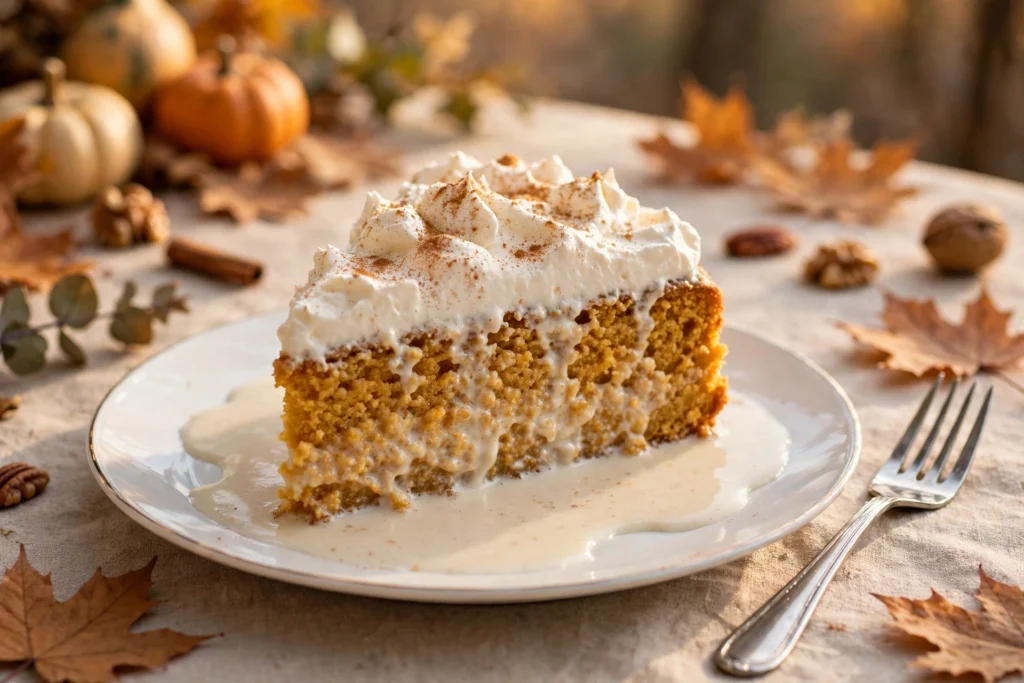
Reduce the heavy cream to 3/4 cup and add 3/4 cup of pumpkin purée, 2 teaspoons of cinnamon, 1/2 teaspoon of nutmeg and 1/2 teaspoon of ground cloves. It tastes like autumn in a slice, and it pairs beautifully with our pumpkin tres leches cake on a fall dessert table.
Matcha Basque Cheesecake
Sift 2 tablespoons of matcha powder in with the flour. The green centre looks stunning against the dark top, and the matcha’s slight bitterness balances the rich filling.
Citrus Basque Cheesecake
Add the finely grated zest of one lemon or orange to the cream cheese with the sugar, and swap 2 tablespoons of the cream for fresh lemon juice. The citrus lifts the whole cake and makes it taste lighter.
Berry Swirl Basque Cheesecake
Warm 1/2 cup of raspberry or strawberry jam until pourable, drizzle it over the batter in the pan, and drag a knife through it once or twice before baking. Do not over-swirl, or the pattern will disappear.
What to Serve With
Purists will tell you a Basque cheesecake needs nothing at all — and honestly, they are mostly right. The cake is complete on its own. But if you are serving it to guests, a small accompaniment turns a slice into a dessert course.
A spoonful of whipped cream or crème fraîche adds a cool contrast to the caramel notes of the top. Fresh berries bring colour and a little acidity that cuts through the richness, while a cup of strong coffee or espresso makes the whole thing feel like a café in San Sebastián.
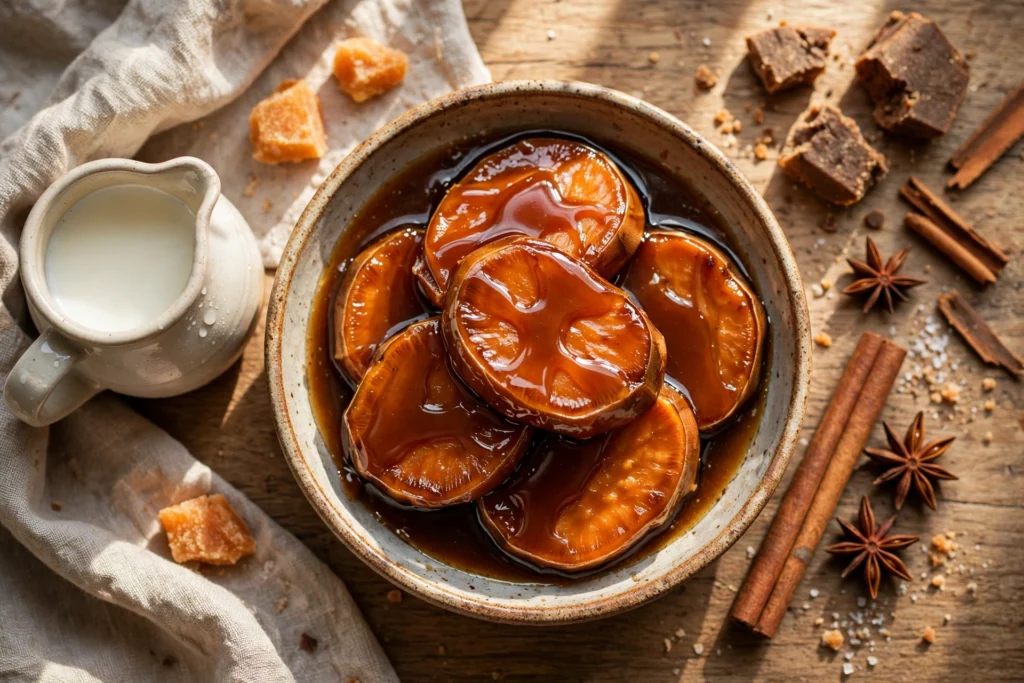
For a fuller dessert spread, serve it with a scoop of vanilla ice cream, or next to a small bowl of Mexican rice pudding for a creamy-desserts table. Either way, keep the portions modest. This cake is rich, and a thin slice is surprisingly satisfying. Drizzle warm cajeta over a slice for a sweet caramel finish.
Storage
Once cold, wrap the whole cake or individual slices tightly in cling film, or place them in an airtight container. It keeps in the fridge for up to 5 days, and the flavour actually improves on day two.
For longer storage, freeze slices individually: wrap each slice in cling film, then in foil, and place them in a freezer bag. Frozen Basque cheesecake keeps for up to 2 months. Thaw a slice overnight in the fridge — never in the microwave, which makes the texture rubbery. Thawed cake is a little softer than fresh, but the flavour holds up well.
Do not leave it at room temperature for more than 2 hours — as a custard-style cake made with cream cheese, eggs and cream, it needs to stay cold.
Frequently Asked Questions
Why does my Basque cheesecake look burnt?
That is the whole point. The deep golden, almost burnt top is the signature of a Basque cheesecake — the caramelised surface gives it its distinctive flavour. If the top is only pale gold, it is under-baked, not prettier.
Why is my Basque cheesecake jiggly in the middle?
A jiggly centre is exactly what you want when the cake comes out of the oven. The cake is baked at a very high temperature, so the edges set and caramelise while the centre stays soft. It firms up as it cools and chills, giving the creamy, custardy texture this cake is known for.
Do I need a water bath for Basque cheesecake?
No. That is one of the best things about this cake — there is no water bath, no crust and no foil wrapping. The high oven temperature and the parchment lining do all the work.
Can I make Basque cheesecake the day before?
Yes — in fact, you should. Basque cheesecake needs at least 8 hours in the fridge, and it tastes better the next day. Make it the evening before you plan to serve it, chill it overnight uncovered, and slice it cold the next day.
Why did my cheesecake sink in the middle?
Sinking is normal. The cake rises high in the hot oven, then settles as it cools, often leaving a shallow dip in the centre. That dip is not a flaw — it is where the custardy texture lives, and it holds toppings beautifully.
Can I freeze Basque cheesecake?
Yes. Slice the cold cake, wrap each slice in cling film and foil, and freeze for up to 2 months. Thaw overnight in the fridge. The texture will be slightly softer than fresh, but the flavour holds up well.
Try These Next
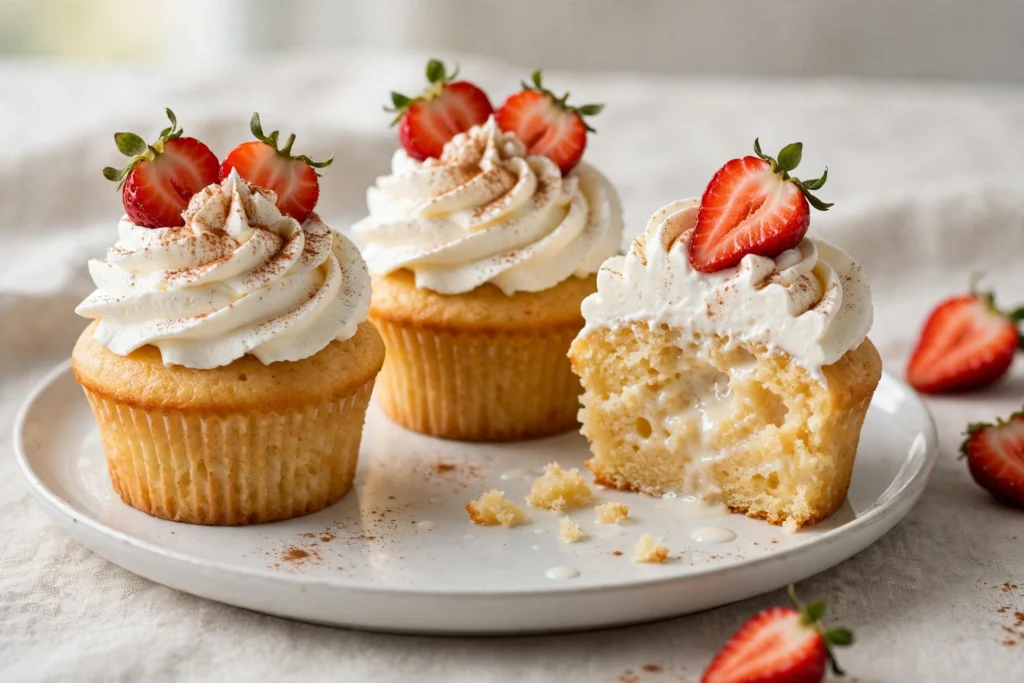
If you enjoyed this creamy, caramel-topped cheesecake, you will love our other rich desserts: tres leches cupcakes for a lighter, milk-soaked treat, capirotada for a warm, spiced bread pudding, or pan de elote for a sweet corn cake that is just as easy.
For a cool, creamy finish, try fresas con crema after the cheesecake.
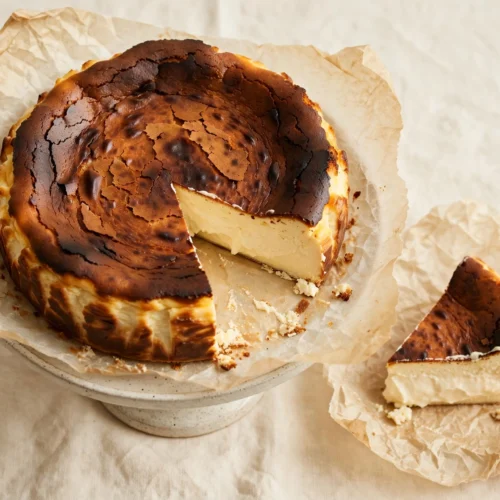
Basque Cheesecake

Ingredients
- 32 oz full-fat cream cheese room temperature (4 blocks)
- 1 1/2 cups granulated sugar
- 5 large eggs room temperature
- 1 large egg yolk room temperature
- 1 1/4 cups heavy whipping cream
- 1/4 cup all-purpose flour
- 2 teaspoons vanilla extract
- 1 teaspoon fine salt
- 1 tablespoon granulated sugar for dusting the top (optional)
Instructions
- Preheat the oven to 425 F (220 C) with a rack in the middle. Scrunch two large sheets of parchment paper into balls, open them out, and press them into a 9-inch springform pan in a cross shape, with the paper rising about 2 inches above the rim.
- Beat the room-temperature cream cheese in a large bowl on medium speed for 2 minutes, scraping down the sides, until smooth and lump-free. Add the sugar and beat on low for 10 seconds.
- With the mixer on low, add the eggs one at a time, beating briefly after each one. Add the egg yolk and vanilla.
- In a separate bowl, whisk the flour with about 1/4 cup of the cream until smooth and lump-free. Whisk in the remaining cream. Pour the cream mixture into the cream cheese bowl in a slow stream while the mixer runs on low. Stop as soon as combined.
- Pour the batter into the prepared pan. Tap the pan firmly on the counter 2 to 3 times and pop any surface bubbles with the tip of a knife.
- Bake for 45 to 55 minutes, until the top is a deep golden brown and the centre still wobbles like soft jelly when you gently shake the pan.
- Cool in the pan on a wire rack for at least 2 hours. Then refrigerate uncovered for at least 8 hours, preferably overnight.
- Release the springform sides, peel away the parchment, and slice with a long sharp knife, wiping the blade clean between cuts.
Notes
- The centre should wobble like soft jelly when the cake comes out of the oven. It firms up in the fridge. A fully set centre means the cake is overbaked.
- Chill the cake uncovered so condensation does not drip onto the browned top. Cover it only once it is fully cold.
- The cake sinks as it cools and may leave a shallow dip in the middle. This is normal for a Basque cheesecake.
- Every oven is different. Judge doneness by colour and wobble, not just by the clock. Some ovens need 45 minutes, others up to 65.
- Store in the fridge for up to 5 days, or freeze individual slices for up to 2 months. Thaw overnight in the fridge.